🇱🇰Country
Sri Lanka: a palace on a rock, a fort on a headland and a rainforest of endemic trees
The Central Cultural Fund says an underground hydraulic system at Sigiriya still partly feeds rainy-season fountains; Galle’s ramparts follow its rocky promontory. UNESCO records 139 of the 217 endemic tree and woody-climber species of Sri Lanka’s lowland wet zone at Sinharaja.
At a glance
A place worth remembering
Sigiriya: water on top of a rock and in the gardens below
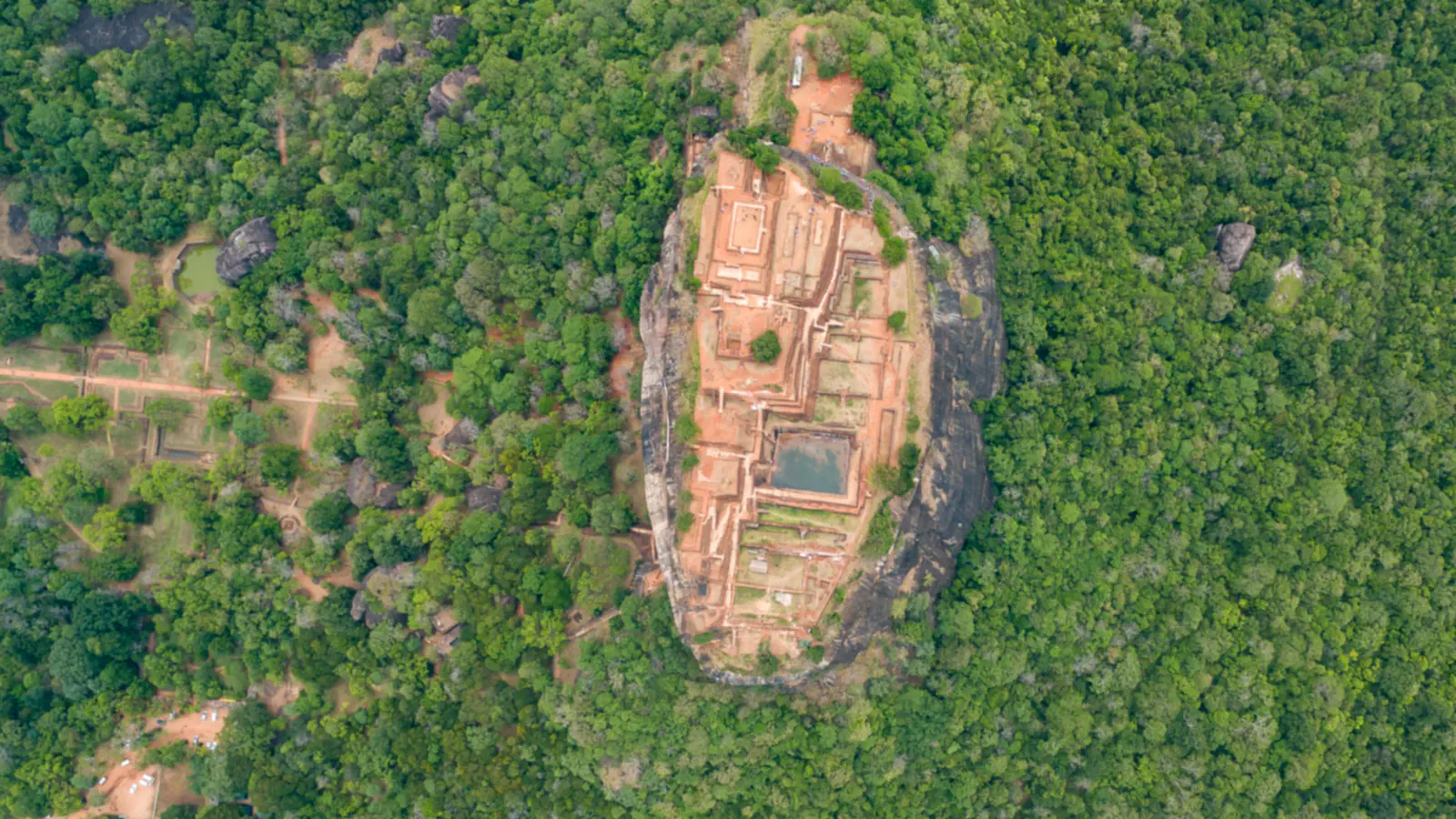
Sigiriya is in Matale District, Central Province. UNESCO describes ruins associated with King Kassapa I (477–495) on the slopes and summit of a steep peak, reached by galleries and staircases that begin at the mouth of a lion made of brick and plaster. The Central Cultural Fund divides the western precinct into three kinds of garden: water gardens with symmetrical pools, channels and fountains; boulder gardens, where brick structures and platforms are built among natural boulders; and terraced gardens connected by stairways. The Fund says the underground hydraulic system still partly works and feeds fountains that run in the rainy season, and that cisterns cut into the rock on the summit stored rainwater.[1][2]
Galle: a Dutch-era street grid inside ramparts shaped by the rock
Galle’s Old Town occupies a small rocky headland on Sri Lanka’s south-west coast, in the Southern Province. UNESCO records that the Portuguese founded it as a fortified town in the 16th century and that it reached its height under Dutch rule in the 18th. In the Dutch street plan, land was divided into blocks so that buildings gathered in a compact area; rows of houses present their narrow sides to the street, with verandas under tall projecting roofs held up by slender columns. The ramparts do not follow a textbook European plan: they trace the rock outcrops of the promontory, with bastions placed seaward and landward, and coral is often used alongside granite in their structure. UNESCO adds that the fortifications and some public buildings are legally owned by the Department of Archaeology.[3]
Sinharaja: ridges and streams in the wet zone
Sinharaja Forest Reserve occupies humid lowland terrain across Sabaragamuwa and Southern Provinces in Sri Lanka’s south-west. UNESCO describes a narrow strip of undulating land with ridges and valleys threaded by streams that drain south to the Gin River and north to the Kalu River. Of the 217 endemic trees and woody climbers found in Sri Lanka’s lowland wet zone, UNESCO reports that 139 (64%) have been recorded here, 16 of them rare. UNESCO reports annual rainfall of 3,614 to 5,006 mm over the previous 60 years; UNESCO links the May–July rainfall period to Sri Lanka’s south-west monsoon and the November–January period to its north-east monsoon. IUCN’s World Heritage Outlook adds that species new to science have been found in the reserve since its 1988 inscription, among them the Serendib scops owl (Otus thilohoffmanni, 2004) and the Sinharaja shrew (Crocidura hikmiya, 2007).[4][5]
Good to know
A few clear answers before you explore.
Do the fountains at Sigiriya still work?
The Central Cultural Fund reports that parts of Sigiriya’s underground water system still operate in the rainy season and feed some fountains.[2]
Why are Galle’s ramparts not laid out in a regular geometric plan?
UNESCO says the ramparts follow the existing form of the site, with its rock outcrops, rather than typical European geometric plans. It ties the bastions to Dutch fortification expertise applied to South Asian terrain that was new to them.[3]
Has anything new been found at Sinharaja since it was listed?
Yes. The IUCN report says many species new to science have been found since the 1988 inscription, among them the Serendib scops owl in 2004 and the Sinharaja shrew in 2007; it lists both as globally endangered.[5]
The WorldStamped community
Every visit becomes part of a story.
- Members with public visits
- 0
- Places with public visits or memories
- 0
- Public memories
- 0
No public visits have been counted here yet. Add this destination to your own map and choose what you want to share.
Members are counted once. Counts include only eligible public activity from profiles that allow search discovery. Private and followers-only content is excluded.