🇹🇭Country
Thailand: a capital built on an island between three rivers
For about 417 years Ayutthaya was the capital of the Siamese kingdom. Its centre is an island where the Chao Phraya, Pa Sak and Lopburi rivers meet, and the plan of its streets and canals is still visible in Phra Nakhon Si Ayutthaya Province.
At a glance
A place worth remembering
Why the capital stood on an island
The Fine Arts Department describes the heart of Ayutthaya as an island ringed by the Chao Phraya, Pa Sak and Lopburi rivers, on a low plain where the three meet; King Ramathibodi I (U-Thong) founded the city there in 1350. UNESCO adds that the site lay above the tidal bore of the Gulf of Siam as it then was, which protected the city from attack by sea-going warships, and that the island also gave some protection from seasonal flooding. Rainy-season water arrived in large volume, so the builders kept the natural rivers and dug canals, mainly in straight north–south lines linked to the rivers, to let water drain out of the town. The canals divided the island into smaller islands for temples, the palace and housing, with roads running beside them and more than 30 bridges across them.[2][1]
Wat Phra Si Sanphet, Wat Mahathat and Wat Ratchaburana
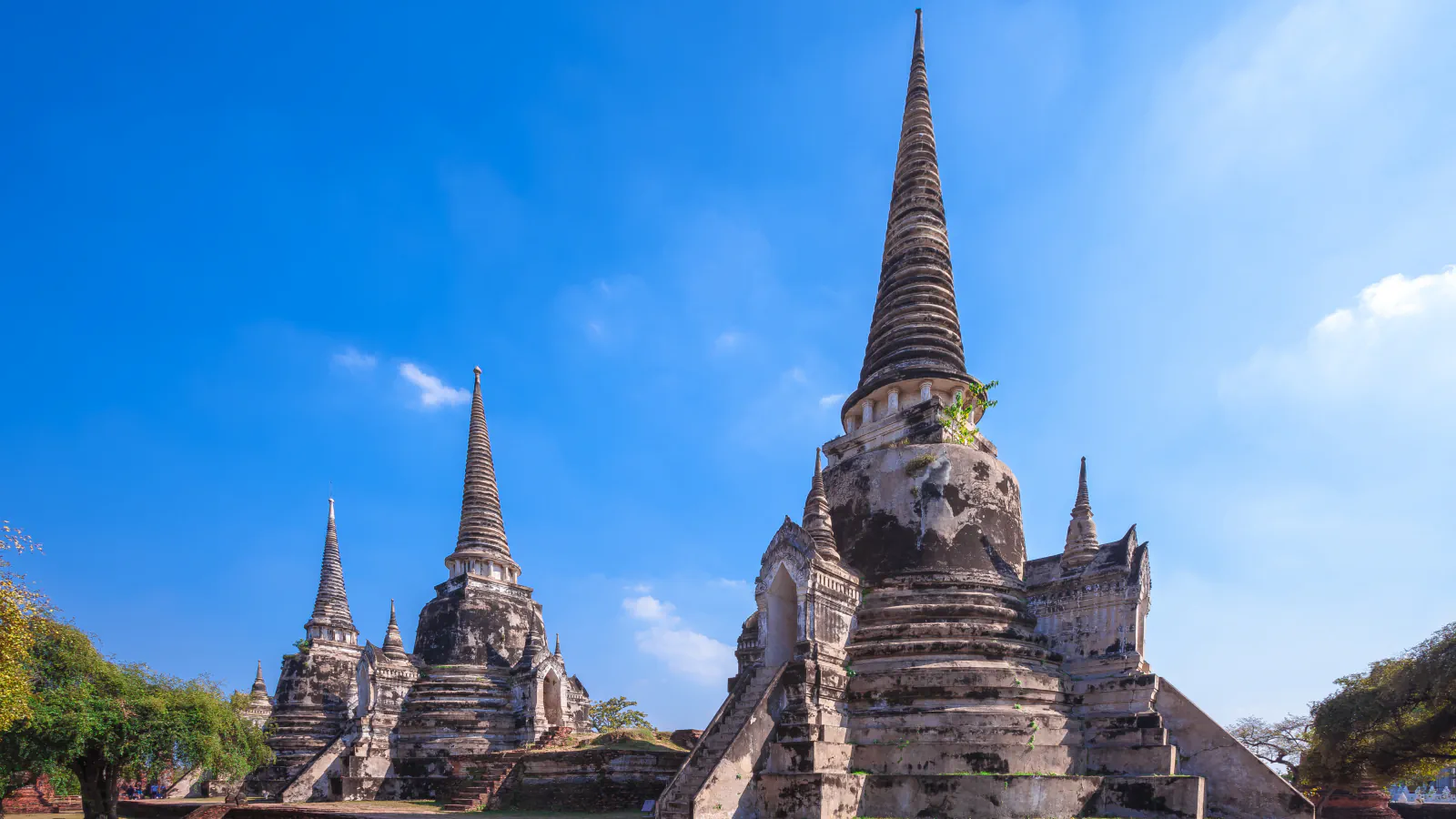
Today the property is an archaeological ruin, marked by prang (reliquary towers) and large Buddhist monasteries. UNESCO names Wat Mahathat and Wat Phra Si Sanphet among the large palaces and monasteries built in the capital, and notes that mural paintings survive in the crypt of Wat Ratchaburana. The Fine Arts Department declared 69 important sites on the island national monuments in 1935; in 1956 excavation and repair work began at Wat Mahathat, Wat Ratchaburana, Wat Phra Si Sanphet, Wihan Phra Mongkhon Bophit and Phu Khao Thong, and the Ayutthaya Historical Park project was set up in 1982. UNESCO says the ruins of the most important buildings have been consolidated, repaired and sometimes reconstructed, and that ruins later built over have been uncovered.[1][2]
After 1767: from capital to archaeological site
In 1767 the Burmese army attacked and razed Ayutthaya, burned it and forced its inhabitants to leave; UNESCO says the city was never rebuilt in the same place. The Fine Arts Department counts 34 kings from five dynasties over the kingdom’s roughly 417 years and says the centre of the country then moved to Thonburi and later Bangkok; after Bangkok was founded in 1782, bricks from Ayutthaya’s walls and religious buildings were taken to help build it. UNESCO writes that Bangkok’s builders also consciously recreated Ayutthaya’s urban template, that many surviving Ayutthaya architects and builders worked on the new capital, and that the name Ayutthaya remains part of Bangkok’s formal title. In 1908 King Chulalongkorn (Rama V) ordered the land of the island kept as public domain, closed to private ownership, which the department calls the first step in conserving Ayutthaya as archaeological and historical evidence.[1][2]
Good to know
A few clear answers before you explore.
Why was Ayutthaya built on an island?
UNESCO says the island lay above the Gulf of Siam’s tidal bore as it then was, which protected it from sea-going warships, and that it also helped against seasonal flooding. The Fine Arts Department adds that the three rivers brought agricultural abundance and made the place a junction for domestic and foreign trade.[1][2]
Which ruins does UNESCO name at Ayutthaya?
Wat Mahathat and Wat Phra Si Sanphet, as examples of the capital’s large palaces and monasteries, and the crypt of Wat Ratchaburana for its surviving mural paintings. UNESCO also describes tall prang (reliquary towers) as characteristic of the ruins.[1]
What happened to Ayutthaya in 1767?
The Burmese army attacked and razed it, burned the city and forced the inhabitants to leave. UNESCO says it was never rebuilt in the same place and remains known as an extensive archaeological site.[1]
The WorldStamped community
Every visit becomes part of a story.
- Members with public visits
- 0
- Places with public visits or memories
- 0
- Public memories
- 0
No public visits have been counted here yet. Add this destination to your own map and choose what you want to share.
Members are counted once. Counts include only eligible public activity from profiles that allow search discovery. Private and followers-only content is excluded.