🇵🇰Country
Pakistan: brick drains at Mohenjo-daro, drilled molars at Mehrgarh, fountain tanks at Shalamar
Each of these three places is documented by archaeologists or conservation reports that give measurements: Mohenjo-daro in Sindh, Mehrgarh in Balochistan and the Shalamar Gardens in Lahore, Punjab. They are three examples from a country with many more places than these.
At a glance
A place worth remembering
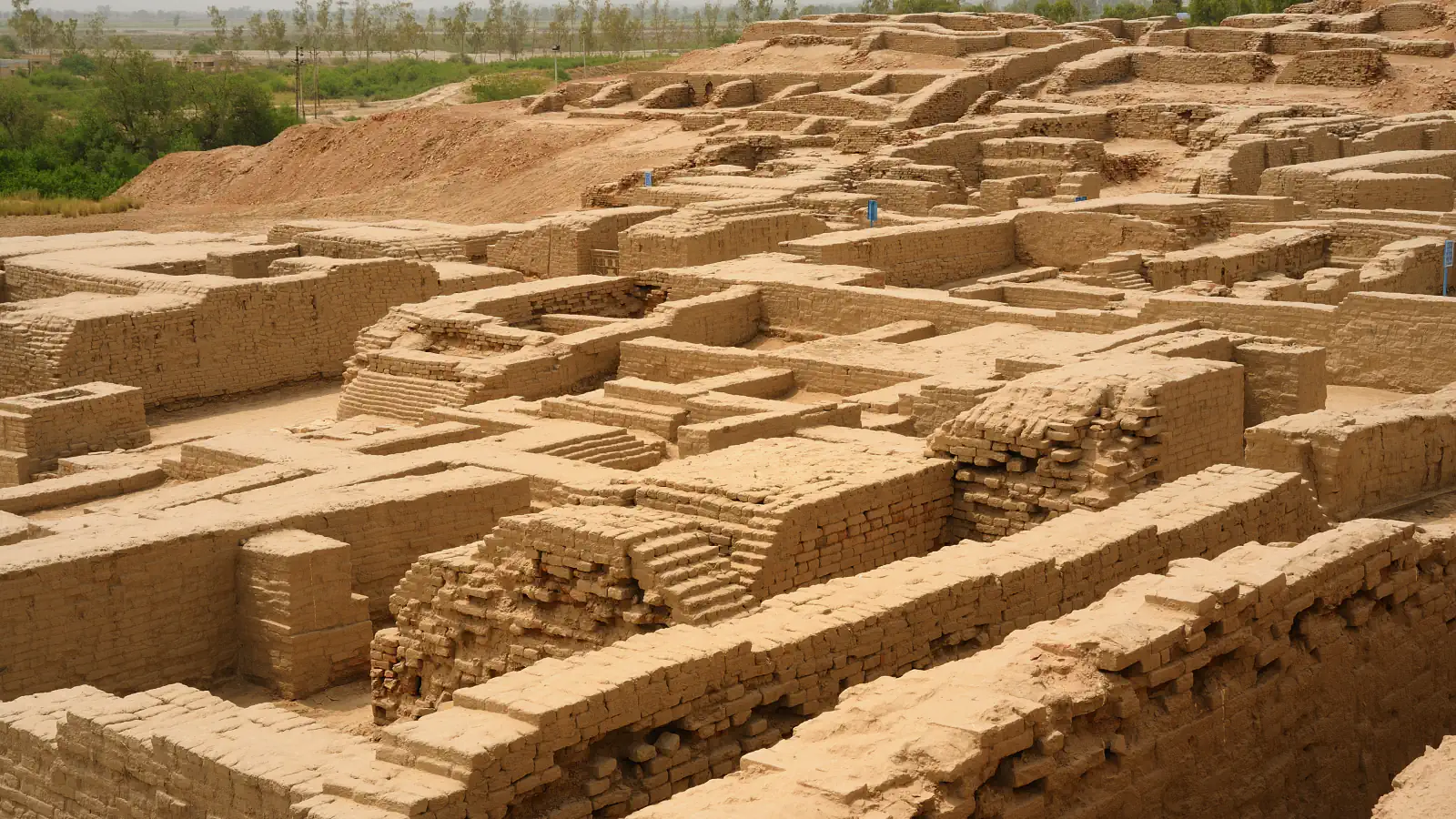
Mohenjo-daro: wedge-shaped bricks in the wells, drains with a fall of 2 cm per metre
Mohenjo-daro stands on the right bank of the Indus in Sindh, about 28 km from Larkana. Michael Jansen’s analysis of its water installations describes brick of one proportion, roughly 6 × 12 × 24 cm, in both burnt and unburnt form. The round well shafts, 60 cm to 2.4 m across, were built of wedge-shaped bricks so that the courses close into a cylinder; Jansen estimates that more than 700 wells once served the city, and reports shafts sunk at least 20 m. Street drains are U-shaped brick channels, mostly on one side of unpaved streets and 50 to 60 cm below street level. Those built of the smaller bricks are 17 to 25 cm wide, fall about 2 cm per metre and were roofed with loose bricks that could be lifted for cleaning. Brick cesspits stood where drains met or ran a long way. Jansen finds no sign that the drains carried rainwater: the streets were unpaved and the rain seems to have soaked into the silty ground.[1][2]
Mehrgarh: a Neolithic graveyard where molars were drilled
Mehrgarh is a group of low mounds on the Kachi plain in Balochistan, near the mouth of the Bolan Pass and about 30 km from the town of Sibi. Pakistan’s Department of Archaeology and Museums describes a sequence more than 11 m deep, from the seventh to the third millennium BC, exposed by a flash flood in the 1970s and excavated by the French Archaeological Mission in 1974 to 1986, which resumed work in 1996. In the early Neolithic graveyard on mound MR3, a team including A. Coppa examined 3,880 permanent teeth from 225 individuals and found eleven drilled molar crowns in nine adults, dated to 7,500 to 9,000 years ago. That is 0.3 percent of the teeth and 4 percent of the individuals. The holes measure about 1.3 to 3.2 mm across and 0.5 to 3.5 mm deep, and none of the 303 baby teeth examined was drilled.[5][3][4]
Shalamar Gardens, Lahore: fountain tanks lost in 1999
The Shalamar Gardens in Lahore, Punjab, were laid out by Shah Jahan in 1641-42. They cover 16 ha in three terraces that descend from south to north and lie about 7 km from Lahore Fort, with which UNESCO treats them as one property. Tanks built to supply the garden’s fountains stood on the south side beside the road; in 1999 they were demolished when the road was widened. In 2000 the World Heritage Committee recorded the complete loss of two of the three hydraulic works and the partial demolition of the third, and the property was on the List of World Heritage in Danger from 2000 to 2012. UNESCO’s 2023 report lists work on the Mughal hydraulic system among the works at Shalamar, and a 2024 mission advised the Pakistani authorities to send details of the restoration of the hydraulic system and landscapes for technical review.[6][7][8][9][10]
Good to know
A few clear answers before you explore.
Did Mohenjo-daro’s drains carry rainwater?
Jansen finds no evidence that they did. The streets were left unpaved, and the drains mainly took domestic waste water from bathing platforms and toilets, which reached them through wall chutes. The loose cover bricks allowed channels and cesspits to be cleared.[1]
Why were the Mehrgarh molars drilled?
The abstract in Nature does not give a reason; it calls the drilled teeth evidence of a long tradition of a type of proto-dentistry in an early farming culture. The supplementary table records probable caries for four of the eleven drilled crowns and none for the other seven.[3][4]
How is Mohenjo-daro protected from salt and floods?
UNESCO’s property record says the foundations are threatened by salt action from a rising Indus water table, which an international UNESCO campaign in the 1970s partly eased. A site office with a laboratory now treats salt, thermal stress and rain with mud slurry, mud capping, re-pointing and underpinning. Embankments and spurs reduce flood risk, but UNESCO notes that a breach of the dam upstream would cause catastrophic damage, so the dam is monitored regularly.[2]
The WorldStamped community
Every visit becomes part of a story.
- Members with public visits
- 0
- Places with public visits or memories
- 0
- Public memories
- 0
No public visits have been counted here yet. Add this destination to your own map and choose what you want to share.
Members are counted once. Counts include only eligible public activity from profiles that allow search discovery. Private and followers-only content is excluded.