City
Manama: a gate that once faced the sea, a house of the Qur’an and towers built around three turbines
Bab Al Bahrain once faced the sea; Beit Al Qur’an’s calligraphy runs from frieze to dome; three turbines sit between the shaped towers of the Bahrain World Trade Center.
At a glance
A place worth remembering
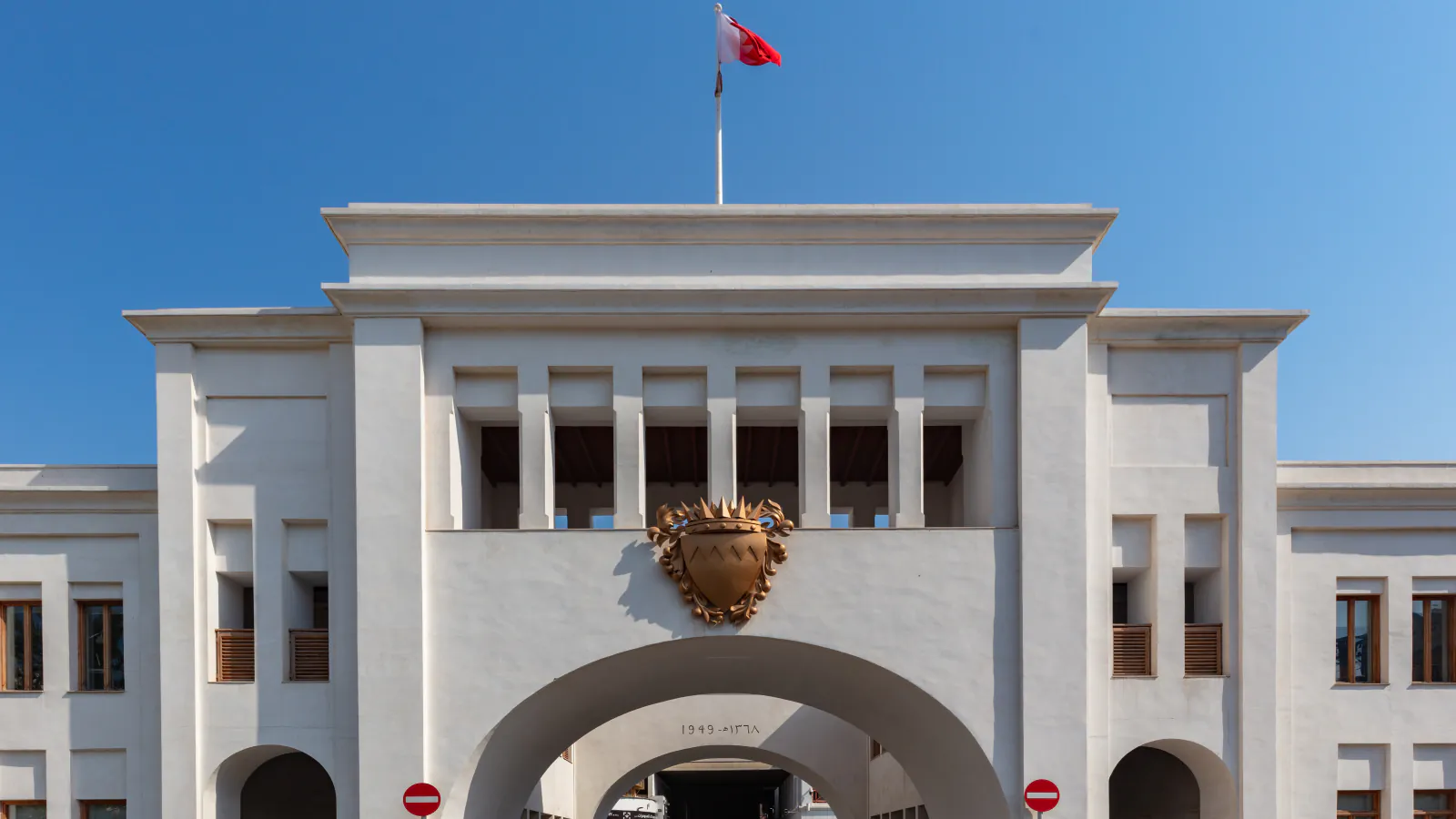
Bab Al Bahrain: a gate that once overlooked the sea
The Bab Al Bahrain gate marks a historic entrance to Manama Suq in the city centre. Bahrain’s cultural-heritage authority says government offices once occupied the building and that it overlooked the sea. The authority’s visitor page says the building houses tourism offices and a visitor centre. Its project page describes a permanent ground-floor gallery and the restoration effort to revive Manama’s old centre. Fuad Al Ansari’s 2009 Newcastle thesis describes the open land north of Prior Road (now Al Khalifa Road) as a working waterfront. People built boats, anchored vessels there, and stored coral stone taken from nearby shallows. Al Ansari writes that Prior Road once lay under water, and that by the late 1920s Sea Road (now Government Road), built over reclaimed land, had become a public area along the shore. Al Ansari notes that the new Sea Road seawall made boatbuilding and coral-stone storage impossible at that spot.[2][3][1]
Beit Al Qur’an: calligraphy from the frieze to the dome
Beit Al Qur’an is in Manama’s Diplomatic Area, off Exhibition Avenue. Bahrain’s cultural-heritage authority lists a mosque, auditorium, madrasa, museum and art exhibitions at the complex. In her May/June 2000 feature, Ni’Mah Isma’il Nawwab describes the Qur’anic frieze on the exterior and the daylight that small stained-glass domes bring into the inner courtyard. Dr Abdul Latif Jassim Kanoo founded the museum. Nawwab says Kanoo entrusted the collection to the 1990 foundation he created to operate the institute and preserve historic manuscripts. Nawwab singles out a manuscript made for Safavid Shah Husayn I on sandalwood, and an octagonal, 43 mm Qur’an written in ghubari script. The mosque’s commissioned glass dome is 16 m wide and bears Verse 18 of Surat al-Tawbah in Egyptian artist Ahmad Mustafa’s hand. The mihrab (prayer niche) is faced with blue ceramic tiles by Turkish craftsmen, and the Throne Verse runs around its perimeter. Nawwab reported in 2000 that the collection included more than 5,000 Qur’anic manuscripts, some complete and some partial.[4][5]
Bahrain World Trade Center: two towers around three turbines
The Bahrain World Trade Center stands on King Faisal Highway. Three turbines are mounted on bridges between its twin towers. Building magazine’s 2008 report describes the towers’ aerofoil-shaped wings as a channel for the wind: the gap between them is 120 m at the front and 30 m at the rear. The report says the 70-tonne turbine bridges were lifted into place as units with strand jacks because a crane could not raise them. A 2015 computational fluid dynamics (CFD) study by Chaudhry, Calautit and Hughes and the Council on Tall Buildings and Urban Habitat entry list each turbine at 225 kW with a 29 m rotor; Consulting-Specifying Engineer reported that all three first turned together on 8 April 2008. Building estimated 1,300 MWh of annual output and reported a forecast share of 10–15% of the building’s energy demand. The 2015 paper cites an estimate of 11–15%, or 1,100–1,300 MWh per year. These are projected figures; the sources read for this page do not give a measured annual total. In its CFD model, the 2015 study reports air speed rising from a 6 m/s reference to 7.1 m/s, with approach speed at the top turbine 17% higher than at the lowest one.[6][7][8][9]
Good to know
A few clear answers before you explore.
Did Bab Al Bahrain once overlook the sea?
Yes. Bahrain’s cultural-heritage authority says Bab Al Bahrain once faced the sea. Fuad Al Ansari adds that Sea Road (now Government Road), built over reclaimed land, had become a public area along the shore by the late 1920s.[2][1]
Do the Bahrain World Trade Center turbines produce what was forecast?
The sources read for this page give forecasts, not measurements: an estimated 1,300 MWh a year and, by the calculations reported by Building magazine, 10–15% of the building’s expected energy demand; the 2015 paper gives 11–15%. Building also reports that the turbines ran for 14 hours in April 2008 and that Shaun Killa of Atkins Middle East said they produced more power than predicted. No measured annual output appeared in these sources.[6][9]
How many manuscripts did an article report in 2000?
In 2000, Ni’Mah Isma’il Nawwab reported that the Beit Al Qur’an collection included more than 5,000 Qur’anic manuscripts, some complete and some partial.[5]
The WorldStamped community
Every visit becomes part of a story.
- Members with public visits
- 0
- Places with public visits or memories
- 0
- Public memories
- 0
No public visits have been counted here yet. Add this destination to your own map and choose what you want to share.
Members are counted once. Counts include only eligible public activity from profiles that allow search discovery. Private and followers-only content is excluded.