🇲🇹Country
Malta, from a carved underworld to a planned city
The Ħal Saflieni Hypogeum in Paola and the city of Valletta on Malta itself, and the Ġgantija temples at Xagħra on Gozo, lie on two islands. They set prehistoric stonework below and above ground beside a city planned as a single creation after a siege. Other parts of the islands are not covered.
At a glance
A place worth remembering
Ħal Saflieni: chambers cut downwards
The Ħal Saflieni Hypogeum in Paola was found in 1902 by a stone mason laying foundations for houses. Its chambers sit on three levels in soft globigerina limestone, cut with chert, flint and obsidian tools and antlers. The people using it dug deeper as space ran short, and the lowest room lies about 10.6 m below ground level. Some chambers appear to imitate temple architecture above ground, with false bays inspired by trilithon doorways and ceilings of overhanging stone rings that echo corbelled masonry. Heritage Malta’s FAQ, checked in October 2026, says only ten people may be inside at one time, because their number affects carbon dioxide, temperature and humidity.[1][2]
Ġgantija: two temples inside one wall
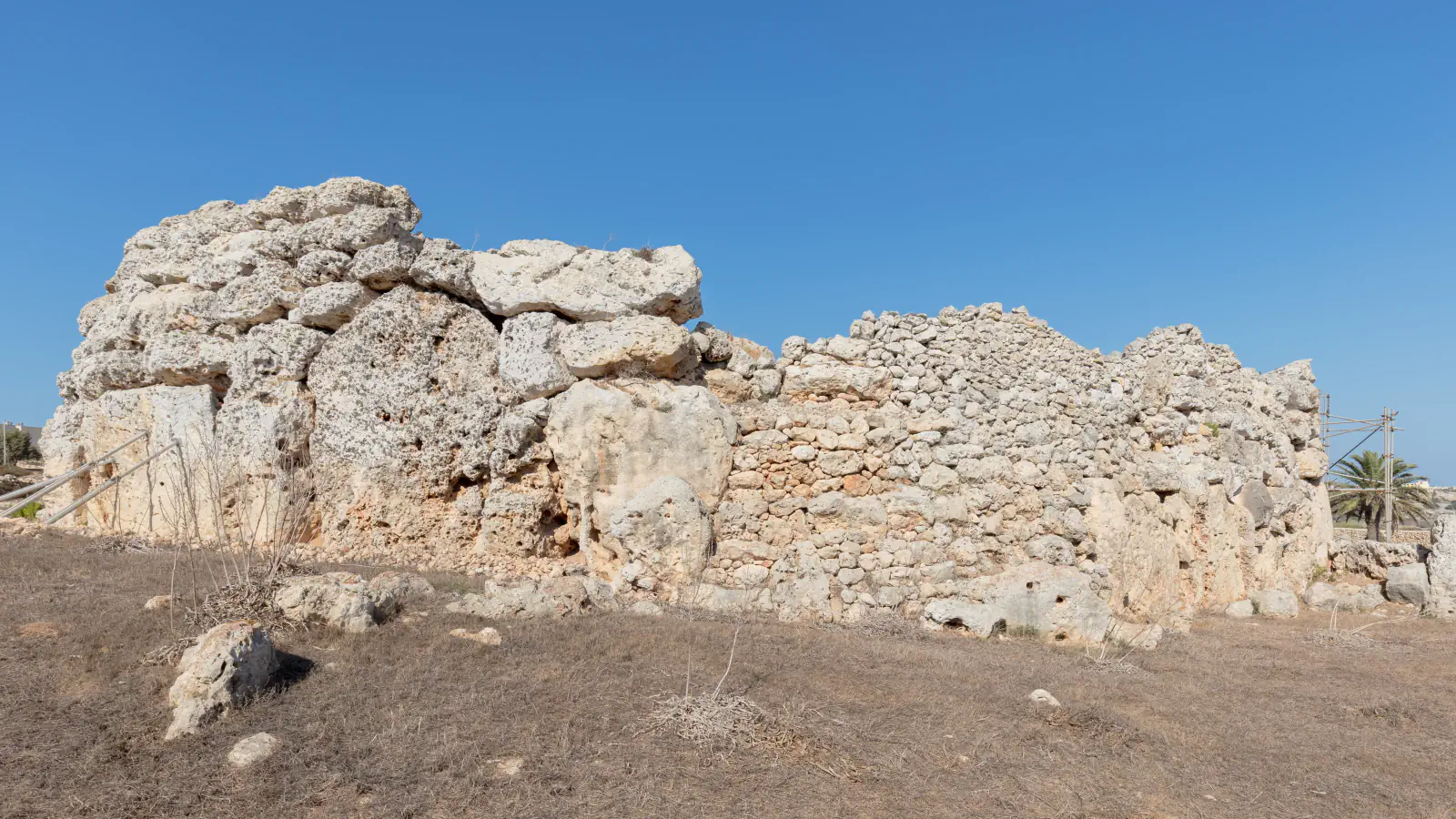
Ġgantija stands on the Xagħra plateau on Gozo. Its two structures have separate entrances but share a common outer megalithic wall, and each has apses flanking a central corridor. The builders used hard coralline limestone extensively for the outer walls and kept softer globigerina limestone, the stone of the Hypogeum, for doorways, altars and decorated slabs. Two plaster fragments with red ochre, shown at the Interpretation Centre, suggest that interior walls were plastered and painted.[3][4][2]
Valletta: a grid laid out after a siege
Valletta occupies a hilly peninsula between two harbours. After the Siege of Malta in 1565 the Knights of St John founded the city in 1566, aided by European military engineers, and laid it out on a uniform grid within bastioned walls. Not everything on the site was new: Fort St Elmo, a star-shaped fort built in 1552, resisted the Ottoman besiegers for a month in 1565 and was brought inside Valletta’s fortifications in 1689.[5][6]
Good to know
A few clear answers before you explore.
Why is entry to the Ħal Saflieni Hypogeum limited?
Heritage Malta says the number of people inside affects carbon dioxide levels, temperature and humidity, which matter for preserving the site, and that the spaces are small. At the time of checking in October 2026, only ten people were allowed in at any one time.[1]
Where is Ġgantija?
On the Xagħra plateau on the island of Gozo. Gozo is an island in its own right, so Ġgantija is a different point on the map from the Hypogeum at Paola and the capital, Valletta.[3][1][5]
Did Valletta exist before the Siege of 1565?
No, the city was founded in 1566. Fort St Elmo, built in 1552, is older and was included within Valletta’s fortifications in 1689.[5][6]
The WorldStamped community
Every visit becomes part of a story.
- Members with public visits
- 0
- Places with public visits or memories
- 0
- Public memories
- 0
No public visits have been counted here yet. Add this destination to your own map and choose what you want to share.
Members are counted once. Counts include only eligible public activity from profiles that allow search discovery. Private and followers-only content is excluded.