🇪🇷Country
Eritrea on three timescales: Asmara's street plan, a million-year-old cranium and stone tools in a raised reef
Asmara's streets were laid out in phases between 1893 and 1941, a cranium from Buia in the Danakil Depression is dated to about 1 million years ago, and stone tools in a raised coral reef at Abdur on the Gulf of Zula to about 125,000 years ago. The three places lie on the central highland plateau, in the Danakil Depression and on the Red Sea coast, so the page does not stand for the whole country.
At a glance
A place worth remembering
Asmara: a street grid that took in a radial pattern
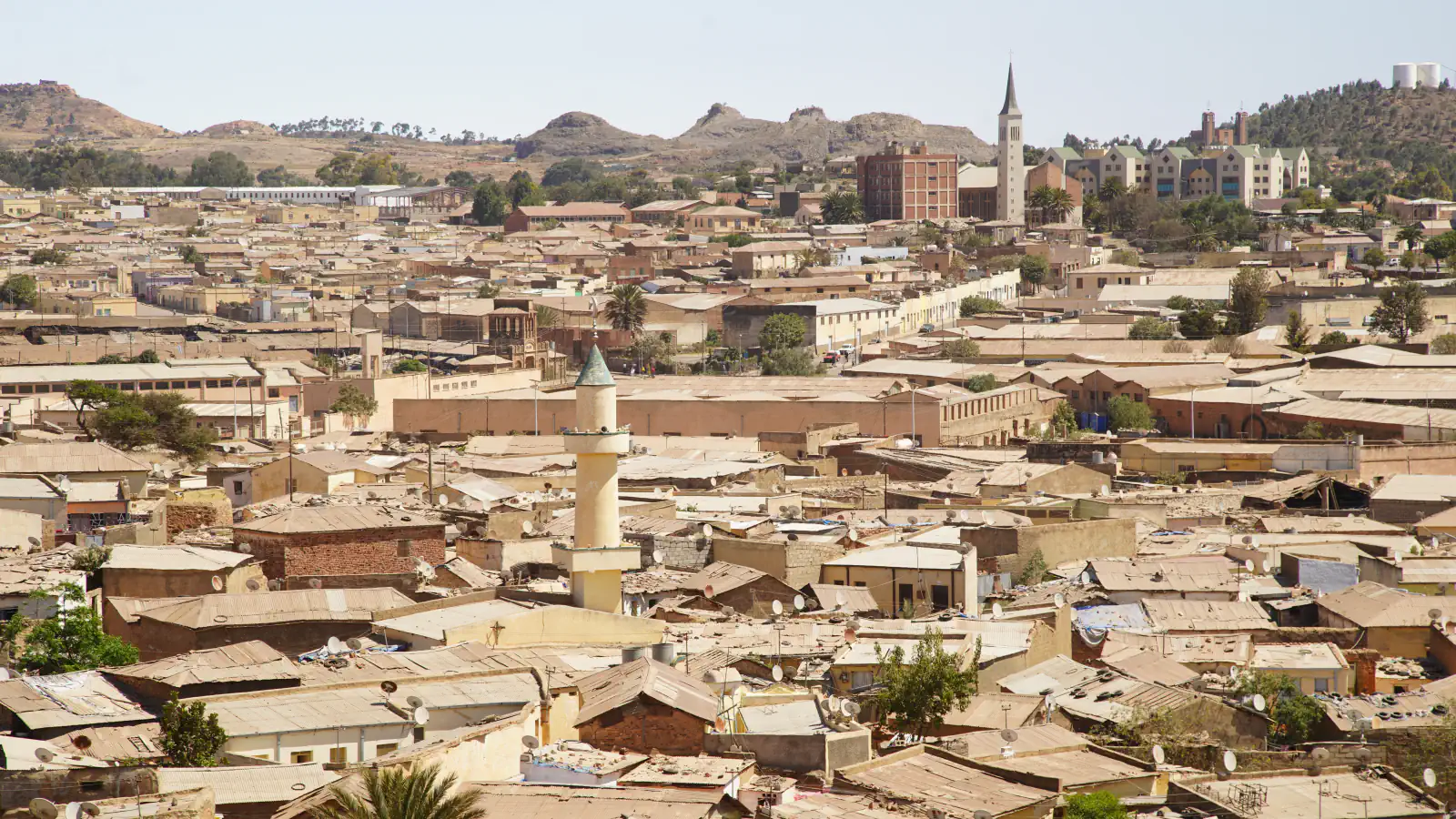
UNESCO places Asmara on a highland plateau at the centre of Eritrea, at over 2,000 m above sea level, and describes the protected area as the part of the city that resulted from phases of planning between 1893 and 1941, together with two unplanned neighbourhoods, Arbate Asmera and Abbashawel. The street layout is mainly an orthogonal grid that later took in elements of a radial system; UNESCO adds that the planning applied principles of functional and racial segregation. Named parts of the urban fabric include Harnet and Sematat avenues, Mai Jah Jah park, the post office on Segeneyti Street and five cinemas: Impero, Roma, Odeon, Capitol and Hamasien. The protected area covers 481 ha, with a buffer zone of 1,203 ha. For protection UNESCO cites the Regolamento Edilizio of 1938, issued at the time of what it calls Cafiero's plan, and a moratorium on new construction since 2001; it also notes that some buildings suffer from lack of maintenance and that some late-20th-century buildings are inappropriate in size, scale or character. These are UNESCO's statements, and its property record is the only source this section uses.[1]
Buia: a cranium dated by magnetic reversals
In 1998 Abbate and colleagues reported in Nature a well-preserved Homo cranium from the northern Danakil (Afar) Depression, with a mixture of characters typical of H. erectus and H. sapiens. It lay in fluvio-deltaic and lacustrine deposits with a rich mammalian fauna of early to early-middle Pleistocene age. A magnetostratigraphic survey found two reversed and two normal magnetozones; the layer with the cranium is near the top of the lower normal magnetozone, which the authors identify as the Jaramillo subchron, so they date the remains to about 1 million years before present. Macchiarelli and colleagues (2004) place the find in the Dandiero (Buia) Basin at the Uadi Aalad site, where fieldwork between 1995 and 2003 produced the cranium UA-31, two permanent teeth and three pelvic portions; they say these represent a single adult, likely female, and that the cranium blends erectus-like features with more progressive ones that are more common in the Middle Pleistocene. A 2026 review by Beyin and Medin adds that stone tools of the Acheulean complex and fossils of land and semi-aquatic animals come from the same Buia–Dandiero area. Only the abstracts of the two older papers were read for this page.[2][3][5]
Abdur: stone tools in a raised coral reef
In 2000 Walter and colleagues reported in Nature early Middle Stone Age artefacts in an emerged reef terrace on the Red Sea coast of Eritrea, dated to about 125,000 years ago by uranium–thorium mass spectrometry on fossil corals; they conclude that early humans were occupying coastal areas and using near-shore marine food resources in East Africa by then. Beyin and Medin (2026) place the Abdur Reef Limestone on the eastern margins of the Gulf of Zula and describe it as made of brain and branching corals, echinoderms, molluscs and shell fragments, formed in a shallow, calm marine embayment during Marine Isotope Stage 5e (about 130–117 thousand years ago), when they say global sea level stood about 8 m above today's. Flakes are embedded in the reef, and bifaces believed to be Acheulean lie in a basal transgressive lag. A survey begun in 2005 recorded more than a dozen Stone Age sites around the southern edge of the gulf and the Buri Peninsula, most of them still undated. The Buia cranium (about 1 million years, Abbate and colleagues) is about eight times older than the Abdur tools (about 125,000 years, Walter and colleagues); that division is this page's own arithmetic. Only the abstract of the 2000 paper was read.[4][5][2]
Good to know
A few clear answers before you explore.
What does the protected area of Asmara include?
UNESCO describes it as the part of the city that resulted from planning phases between 1893 and 1941, plus the unplanned neighbourhoods of Arbate Asmera and Abbashawel. The protected area is 481 ha and the buffer zone 1,203 ha. UNESCO also notes that some buildings suffer from lack of maintenance. This is UNESCO's description, and the page does not say which buildings can be entered.[1]
How was the Buia cranium dated?
Abbate and colleagues ran a magnetostratigraphic survey that found two reversed and two normal magnetozones. The layer with the cranium is near the top of the lower normal magnetozone, which they identify as the Jaramillo subchron, so they date the remains to about 1 million years before present. The cranium UA-31 comes from the Uadi Aalad site in the Dandiero (Buia) Basin, according to Macchiarelli and colleagues. The page relies on the abstracts of both papers.[2][3]
How old are the stone tools at Abdur, and how do we know?
Walter and colleagues dated an emerged reef terrace holding early Middle Stone Age artefacts to about 125,000 years ago, using uranium–thorium mass spectrometry on fossil corals. Beyin and Medin (2026) put the reef's formation in Marine Isotope Stage 5e, about 130–117 thousand years ago, and say that flakes are embedded in the reef while bifaces believed to be Acheulean lie in a basal lag. The page relies on the abstract of the 2000 paper.[4][5]
The WorldStamped community
Every visit becomes part of a story.
- Members with public visits
- 0
- Places with public visits or memories
- 0
- Public memories
- 0
No public visits have been counted here yet. Add this destination to your own map and choose what you want to share.
Members are counted once. Counts include only eligible public activity from profiles that allow search discovery. Private and followers-only content is excluded.