🇩🇯Country
Djibouti: Asal rift, Forêt du Day and whale sharks in the Gulf of Tadjoura
A week-long eruption during the 1978 Asal–Ghoubbet event accompanied about 2 m of horizontal extension across the rift. A detailed Forêt du Day survey in 2007 estimated a 95% confidence interval of 285–705 francolins; the authors suggested the total may lie in the lower half of that interval, 285–450. Across six campaigns at two Gulf of Tadjoura feeding sites, researchers recorded 111 surface sightings and photographs distinguished 83 individual immature whale sharks over five sampled years (2017–2025).
At a glance
- Asal rift, 1978–2003
- Vigny et al. estimated 16 ± 1 mm/year of rift opening in a 1978–2003 geodetic series, versus 13 ± 1 mm/year for large-scale Arabia–Somalia motion.[1]
- Francolins in the Forêt du Day
- Estimated 95% confidence interval: 285–705 birds; Fisher et al. suggested the total may lie in the lower half, 285–450 (2007 survey).[3]
- Whale sharks identified
- 83 photo-identified immature whale sharks among 111 surface sightings during six campaigns at two feeding sites from 2017 to 2025.[4]
A place worth remembering
Asal–Ghoubbet rift: what the geodetic record shows
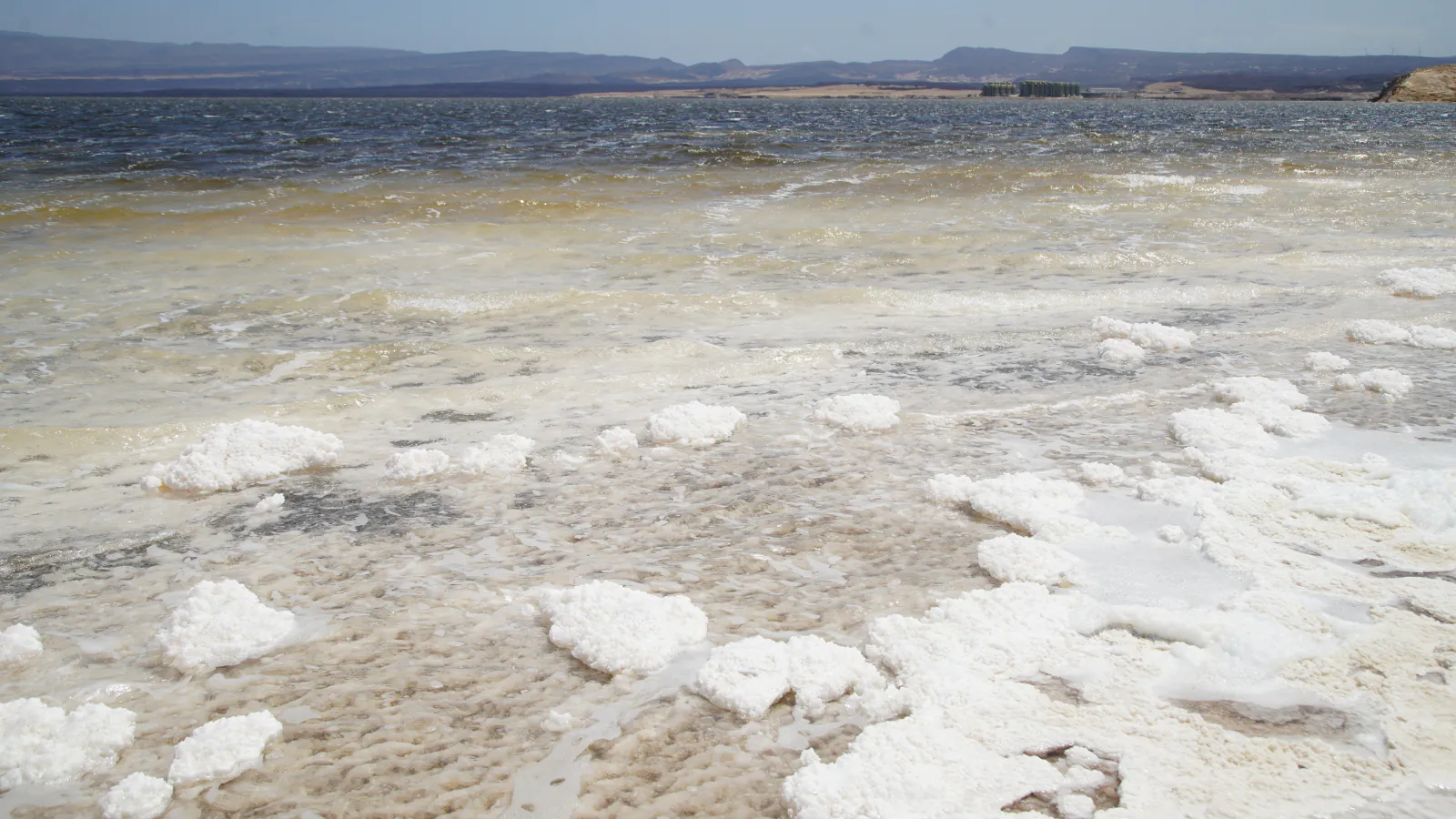
Aden and colleagues (2021) place Lake Asal in a depression about 150 m below sea level. They describe saline groundwater originating in the Ghoubbet Sea, about 12 km south-east of the lake, and use a hydrogeological model to examine how regional groundwater flow may affect hydrothermal circulation. Their account of the 1978 sequence records two rift earthquakes, with magnitudes 5 and 5.3, and about 2 m of horizontal extension. Vigny and colleagues (2007) link that extension to the week-long 1978 eruption. Vigny et al.’s geodetic series for 1978–2003 gives local opening across the rift at 16 ± 1 mm per year, alongside large-scale Arabia–Somalia plate motion at 13 ± 1 mm per year. They suggest the excess could reflect transient relaxation after the 1978 sequence; the rate is not constant.[2][1]
Forêt du Day: woodland and francolin estimates
Fisher and colleagues’ 2009 Oryx paper reports a detailed survey carried out in May–June 2007. Its distance model gave a 95% confidence interval of 285–705 birds for the 7.5 km² study area; the authors suggested the total may lie in the lower half of that interval, 285–450. The field observations show sharply different habitat conditions: lightly grazed eastern Barabarre had dense living juniper, while Garab had open Buxus hildebrandtii woodland and dead junipers. Their model also found a statistically significant pattern in tree-rich plots: higher grazing intensity went with lower francolin presence.[3]
Gulf of Tadjoura: what surface surveys recorded
Reinero and colleagues (2025) studied surface sightings of immature whale sharks at two feeding hotspots, Arta Beach and Ras Korali, during six campaigns over five study years. Across 111 surface sightings, including re-sightings, photographs distinguished 83 individual whale sharks. Their GAM count model associated higher counts with chlorophyll-a above 0.5 mg/m³ and sea-surface temperature above 26 °C; the influence of wind was weaker and more intricate. These figures describe observations at the sampled sites, not all whale sharks in the gulf.[4]
Good to know
A few clear answers before you explore.
What does the Asal rift’s 16 mm/year figure describe?
Vigny and colleagues derived it from geodetic measurements spanning 1978–2003: their estimate for local rift opening was 16 ± 1 mm per year, compared with 13 ± 1 mm per year for large-scale Arabia–Somalia motion. They suggest the difference may include transient relaxation after the 1978 sequence and emphasise that the rate varies. Aden and colleagues separately describe the 1978 eruption and extension.[1][2]
How did the Forêt du Day survey estimate francolin numbers?
The density model was extrapolated across the 7.5 km² study area, giving a 95% confidence interval of 285–705 birds. The authors caution that nearby transects could register the same birds twice and visibility varied among habitats; they therefore suggested the total may lie in the lower half, 285–450.[3]
Do 111 whale-shark sightings mean 111 different animals?
No. The sightings include repeat encounters; photo-identification distinguished 83 individuals among the 111 surface records. The study covered two feeding sites, so these figures are not a Gulf-wide population estimate.[4]
The WorldStamped community
Every visit becomes part of a story.
- Members with public visits
- 0
- Places with public visits or memories
- 0
- Public memories
- 0
No public visits have been counted here yet. Add this destination to your own map and choose what you want to share.
Members are counted once. Counts include only eligible public activity from profiles that allow search discovery. Private and followers-only content is excluded.