🇧🇬Country
Bulgaria: a monastery, glacier-shaped mountains and a Thracian tomb
Rila Monastery in the Rila Mountains keeps a stone tower from the 1330s; the Pirin Mountains in the south-west were shaped by glaciers; and a Thracian tomb at Kazanlak was found in 1944 by soldiers digging an air-raid shelter.
At a glance
A place worth remembering
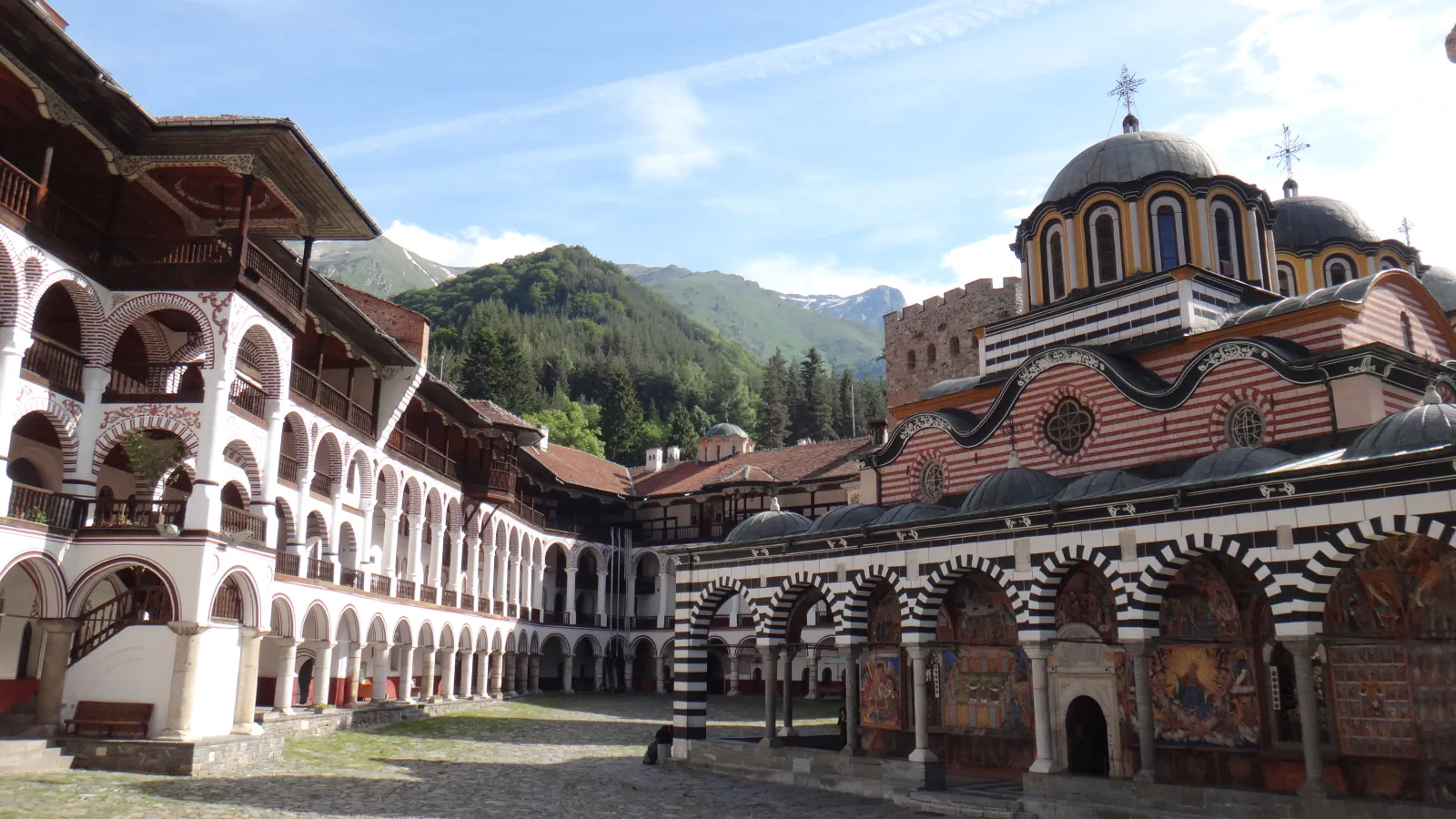
Rila Monastery: a tower from the 1330s, a complex rebuilt from 1834
Rila Monastery lies in the Rila Mountains where the Drushlyavitsa and Rilska rivers meet; the monastery names the hermit St John of Rila as its founder in the first half of the 10th century. Its own history says manuscripts have been kept there since the 11th century, among them a Glagolitic copy of a text by St Ephrem the Syrian, and that in 1466 it signed a treaty of mutual help and refuge with the Russian monastery of St Panteleimon. The stone Hrelyo Tower, built in the 1330s, has five floors and is 23.60 m high; a chapel on its top floor holds frescoes from the 14th century. UNESCO records that the complex was destroyed by fire at the beginning of the 19th century and rebuilt between 1834 and 1862. The monastery’s Church History Museum shows manuscripts and old printed books, with a miniature wood-carved cross made by the monk Raphael at the beginning of the 19th century at the centre of the display.[1][2][3][4]
Pirin: mountains shaped by ice
The Pirin Mountains lie in south-western Bulgaria between the valleys of the Struma and the Mesta. The Pirin National Park Directorate explains that the last major uplift came during the Ice Age, and that glaciation left deep cirques, moraines, glacial valleys and lakes. It counts 35 cirques, large and small, and more than 50 marble and granite peaks above 2,500 m inside the park. Protection grew in stages: Vihren People’s Park, 6,736 ha, was declared on 8 November 1962; in 1974 the area became Pirin People’s Park at 26,413.8 ha, and in 1987 a further 12,639 ha were added; it became a national park in 1999. The directorate now speaks of more than 40,000 ha, while UNESCO’s World Heritage property overlaps the park except for two skiing areas. In its Vihren section, whose office is in Bansko, the directorate points to Baykusheva mura, a tree of the species Pinus heldreichii that it puts at more than 1,300 years old, about 8 m round the trunk and 22 m tall.[5][6][7][8]
Kazanlak: a Thracian tomb found while digging a shelter
The Thracian Tomb of Kazanlak, in Stara Zagora Province, was found by chance on 19 April 1944, according to Kazanlak Municipality, when soldiers were digging an air-raid shelter. It consists of a corridor, a rectangular antechamber and a round burial chamber. The domed chamber is 2.65 m across and 3.25 m high, and its walls carry murals in tempera and fresco; the main frieze shows a scene interpreted as a funeral feast. The burial goods were robbed in antiquity. The sources date the tomb differently: UNESCO to about the end of the 4th century BC, the municipality to the first half of the 3rd century BC. The original, in Tyulbeto park, is under a special preservation regime, and a 1:1 replica stands next to it. The Ministry of Tourism lists the tomb within the Valley of the Thracian Kings, which also includes mounds such as Golyama Kosmatka and Shushmanets.[9][10][11]
Good to know
A few clear answers before you explore.
When was Rila Monastery rebuilt?
UNESCO records that the complex was destroyed by fire at the beginning of the 19th century and rebuilt between 1834 and 1862. The stone Hrelyo Tower, which the monastery dates to 1335, is preserved from the medieval complex.[4][2]
What shaped the landscape of Pirin?
Glaciation, according to the park directorate: it left cirques, moraines, glacial valleys and lakes, and the directorate counts 35 cirques inside the park.[5]
How was the Kazanlak tomb discovered?
By chance on 19 April 1944, when soldiers were digging an air-raid shelter, according to Kazanlak Municipality. The original is under a special preservation regime; a 1:1 replica stands beside it in Tyulbeto park.[9][10]
The WorldStamped community
Every visit becomes part of a story.
- Members with public visits
- 0
- Places with public visits or memories
- 0
- Public memories
- 0
No public visits have been counted here yet. Add this destination to your own map and choose what you want to share.
Members are counted once. Counts include only eligible public activity from profiles that allow search discovery. Private and followers-only content is excluded.