🇬🇷Country
Greece, where the landscape shaped the sanctuary
Greece spans mainland mountains and Aegean islands, and three of its World Heritage properties show how setting guided belief and public life. Monks built on sandstone peaks at Meteora, pilgrims came to Apollo’s oracle at Delphi, and a small island, Delos, turned from sanctuary into marketplace.
At a glance
A place worth remembering
Meteora was listed for its rock as well as its monasteries
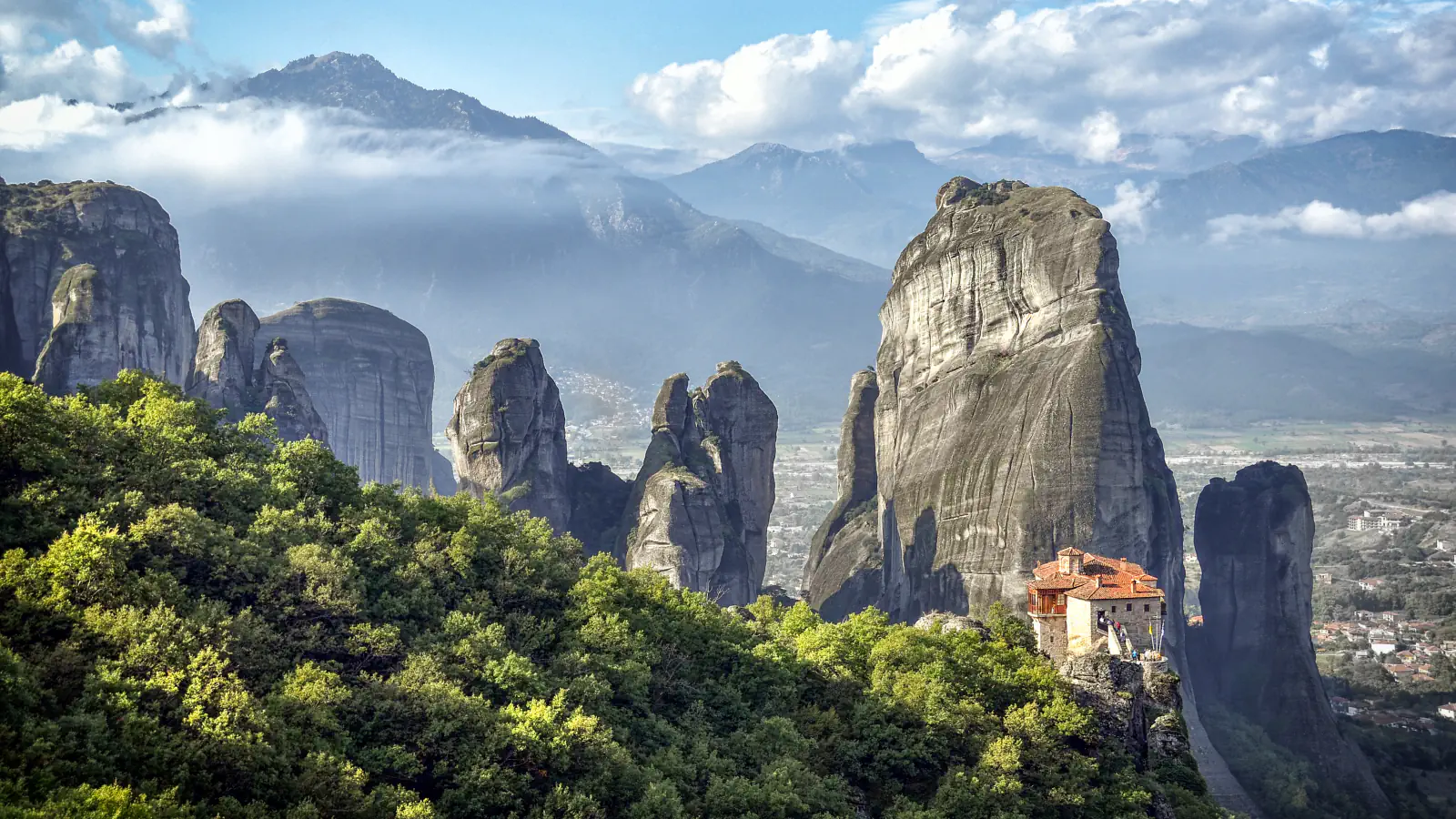
In Thessaly, monks began settling among Meteora’s sandstone pillars during the 11th century. By the late 15th century, twenty-four monasteries had been built there despite the difficult terrain. UNESCO inscribed the property in 1988 under five criteria, including (vii) for its exceptional natural beauty. UNESCO says the sandstone peaks, which rise more than 400 metres above ground level, were created about 60 million years ago from river-delta deposits and later carved by earthquakes, rain and wind. Theophanes the Cretan painted frescoes in the Saint Nicholas Anapafsas monastery in 1527; UNESCO says they became a basic reference for post-Byzantine painting.[1][4]
At Delphi, the mountainside shaped the sanctuary
Delphi lies below Mount Parnassus, in the gap between two steep rocks in Phocis, Central Greece. UNESCO records Mycenaean remains from 1500–1100 BC and dates the start of the sanctuary’s and oracle’s development to the 8th century BC. It adds that the main features of the natural setting shaped how the cults were organised. UNESCO says pilgrims from across the then-known world travelled to consult the oracle, delivered by the Pythia, Apollo’s priestess; ancient Greeks regarded Delphi as the centre of the world. The Theatre and Stadium hosted the Pythian Games every four years. UNESCO inscribed the site in 1987.[2]
How Delos shifted from sanctuary to port
Delos is a small, rocky island of about 350 hectares in the centre of the Aegean Sea. Greek tradition places Apollo’s and Artemis’s birth there; an Apollo sanctuary existed by the 9th century BC at the latest. UNESCO links the island’s commercial rise to its designation as a free port in 167 BC: merchants, bankers and ship-owners settled there and commissioned houses decorated with frescoes and mosaics. Raids in 88 and 69 BC preceded a rapid decline. Excavations begun in 1872 continue today, and the whole island is treated as an archaeological site.[3]
Good to know
A few clear answers before you explore.
Which World Heritage criteria apply to Meteora?
Five: (i), (ii), (iv), (v) and (vii). They cover the monasteries’ architecture, the influence of the 1527 frescoes, the fragile traditional way of life on the cliffs and the area’s exceptional natural beauty.[1][4]
What did people travel to Delphi for?
People travelled to Apollo’s sanctuary to consult the Pythia. Delphi also hosted the Pythian Games on a four-year cycle, with events at its Theatre and Stadium.[2]
Why did Delos become a trading centre?
A free-port declaration in 167 BC brought eastern Mediterranean trade to Delos, UNESCO says. Wealthy merchants, financiers and ship-owners then settled on the island and commissioned decorated homes.[3]
The WorldStamped community
Every visit becomes part of a story.
- Members with public visits
- 0
- Places with public visits or memories
- 0
- Public memories
- 0
No public visits have been counted here yet. Add this destination to your own map and choose what you want to share.
Members are counted once. Counts include only eligible public activity from profiles that allow search discovery. Private and followers-only content is excluded.