City
Athens through the Agora
The American School’s excavation account connects Agora finds with both civic and household life: evidence tied to public administration appears alongside pottery from homes near the square. The reconstructed Stoa of Attalos now houses the site museum and excavation archive. Nearby, the Acropolis offers a contrasting setting, a fortified hill with a long religious history.
At a glance
A place worth remembering
Finds from the public square and nearby homes
Systematic excavation began in 1931. The School dates some pottery from the Agora area to around 3000 BCE and says its research focuses on Agora material from the fifth and fourth centuries BCE. Finds tied to civic administration are one strand of the record, alongside household pottery and traces of homes bordering the square. Read together, they show how the public space related to domestic life.[1][2]
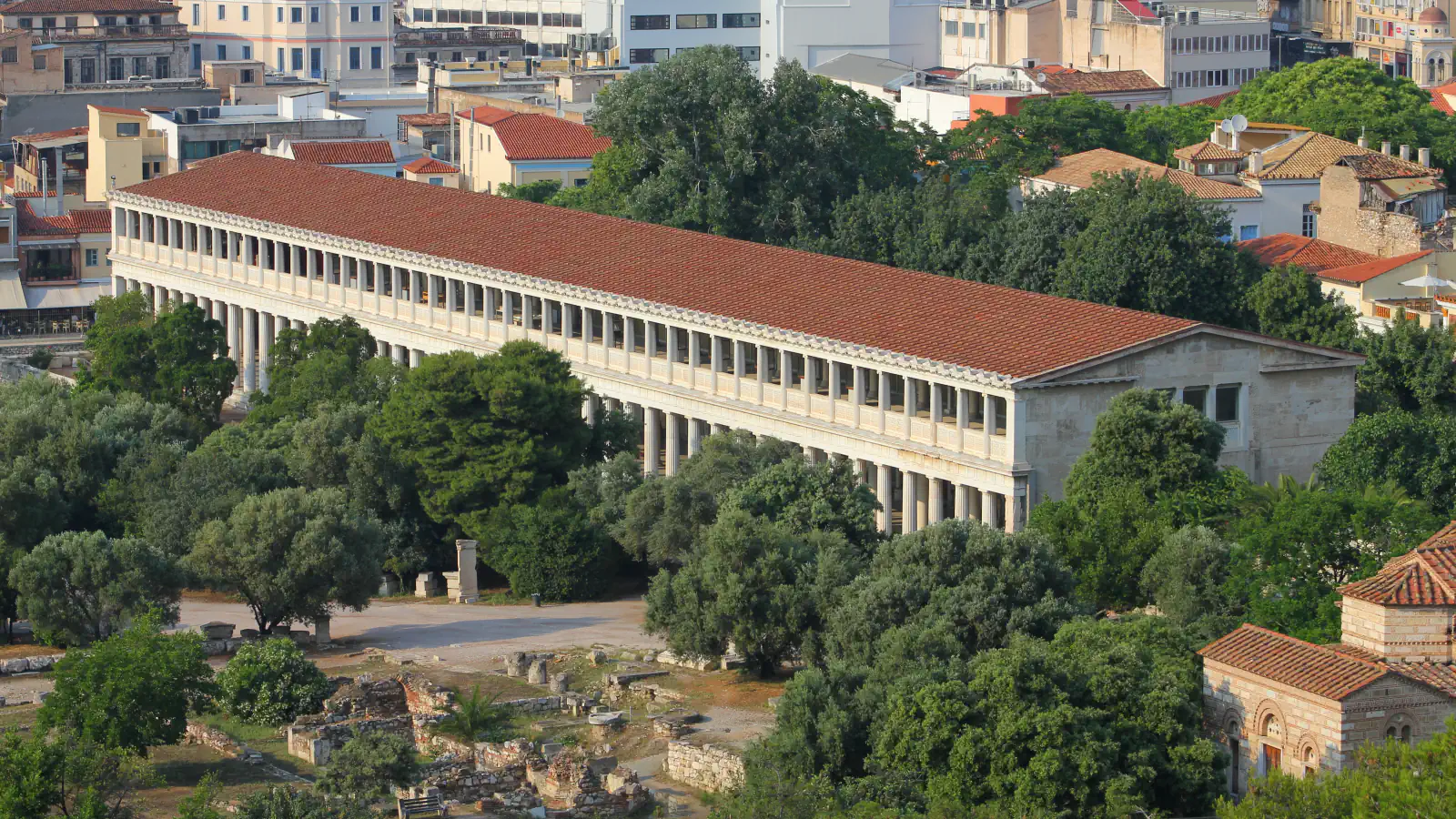
A reconstructed stoa with an excavation archive
Attalos II of Pergamon (159–138 BCE) built the original Hellenistic stoa, according to the School’s timeline. Its present building is a reconstruction: work began in 1953, and the timeline records its dedication on 3 September 1956. The School describes the project as funded by American donors and names John D. Rockefeller Jr. among its major benefactors. The ground-floor museum displays selected objects; the Stoa also holds excavated material with its archaeological records, so researchers can consult the finds alongside their documentation.[1][2][3][4][5]
A fortified hill with a different history
The open Agora and the Acropolis offer contrasting settings. UNESCO describes the Acropolis as a rocky hill with a broad, nearly level summit; its account gives an average height of 156 m and dimensions of about 170 by 350 m. It dates a fortification around a local Mycenaean ruler’s residence to the 13th century BCE and places the development of Athena’s cult on the hill in the 8th century BCE.[6]
Good to know
A few clear answers before you explore.
Is the Stoa of Attalos an ancient building?
Not in its present form. Attalos II built the Hellenistic original; the structure on the site today is a reconstruction, dedicated on 3 September 1956.[2][1]
What does the Agora’s evidence say about life around the square?
The School describes evidence of public administration alongside remains of homes and household pottery near the open area.[1]
Are all Agora finds on display?
No. The American School’s visitor page says the ground-floor museum displays a selection; the Stoa also houses excavated material with its archaeological records.[4][5]
The WorldStamped community
Every visit becomes part of a story.
- Members with public visits
- 0
- Places with public visits or memories
- 0
- Public memories
- 0
No public visits have been counted here yet. Add this destination to your own map and choose what you want to share.
Members are counted once. Counts include only eligible public activity from profiles that allow search discovery. Private and followers-only content is excluded.