City
Brazzaville: a brick cathedral, a basilica under green tiles and a painting school
How things were made links these sites in Brazzaville, in the Republic of the Congo: a cathedral of fired brick begun in 1892, a basilica of concrete and local materials roofed with glazed tiles from France, and a painting school founded in 1951 that taught no academic technique.
At a glance
- Country
- Republic of the Congo[5]
A place worth remembering
Sacré-Cœur: a cathedral of fired brick
Sacré-Cœur, called a cathedral in the heritage dossier, stands in the old Mission quarter, which was granted to the Holy Ghost Fathers (Spiritans) in 1887 and runs from the hilltop down to the Congo river. Work began in 1892 at the initiative of Mgr Prosper Augouard, the dossier says; the Spiritans’ own chronology puts the start five years after the mission’s foundation. The walls are fired brick laid in a mortar of sand and clay. The two bell towers, with terracotta statues of Saints Peter and Paul, were added in 1902–1904, and an apse and a transept built in the 1910s gave the plan its Latin-cross form. The dossier lists restorations in 1952, 1982 and 1993; the first was by Roger Erell, the architect of the basilica.[1][3]
Sainte-Anne-du-Congo: a Latin cross under green scales
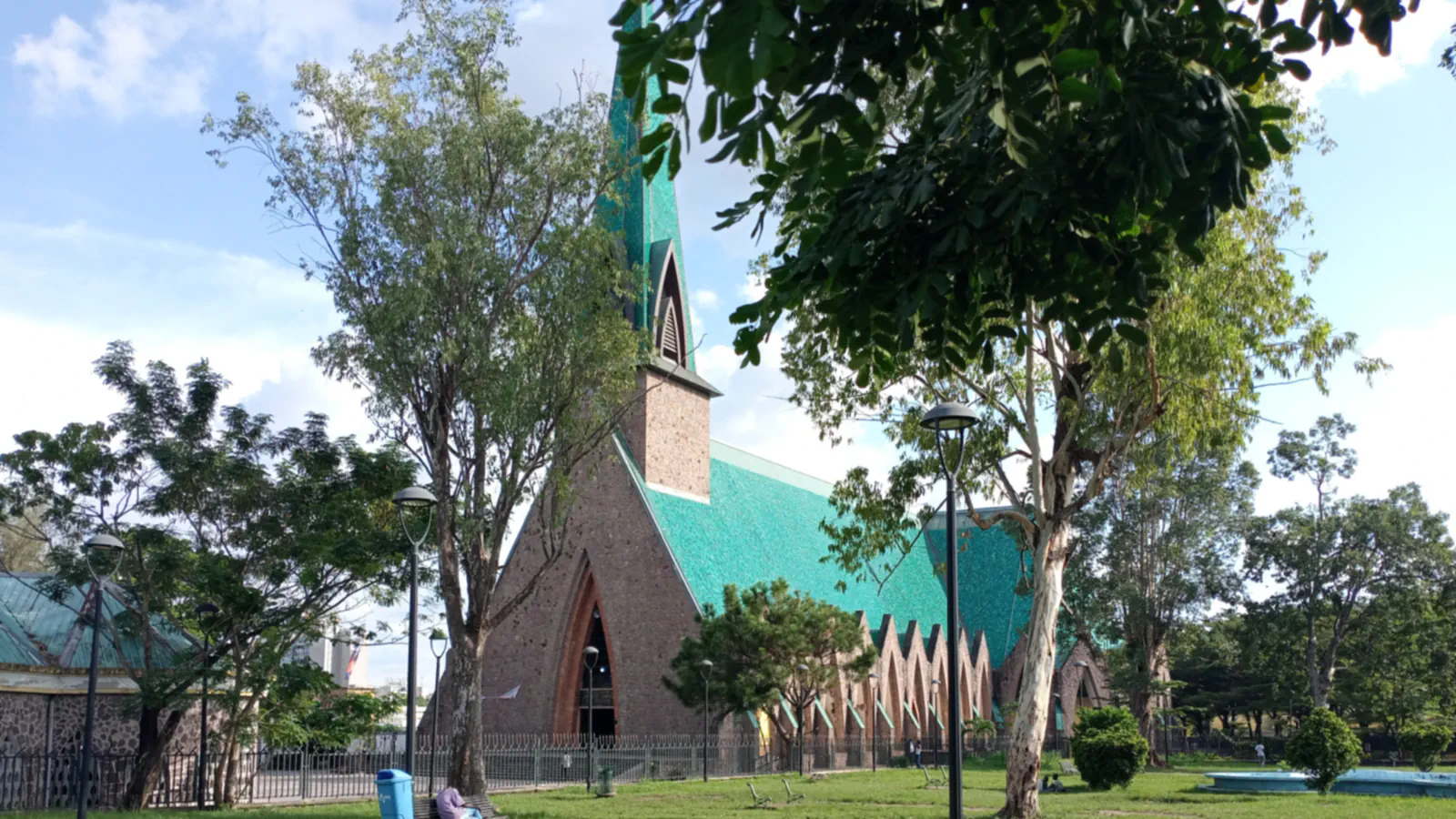
A survey note in the journal In Situ credits the basilica of Sainte-Anne-du-Congo to Roger Erell, working with the engineer William Barnett and then the engineer Grandmaître; work began in 1943 and was still unfinished at the inauguration in 1949. The heritage dossier describes a European Latin-cross plan inside an envelope inspired by the domed huts of the Logone region in Chad, built of concrete with local materials (bricks fired on the spot and Djoué sandstone), under green glazed tiles shaped like scales that were imported from France. Light enters from above, and the dossier names Pierre Lods and Benoît Konongo among the artists who decorated the church. The dossier records that the basilica was rebuilt between July 2010 and January 2011.[2][1]
The Poto-Poto painting school: bright colour, black outlines
The École de peinture de Poto-Poto was founded in 1951 by the Frenchman Pierre Lods; the heritage dossier says it began as the “centre d’art africain”. Lods did not teach academic Western technique. ADIAC describes students given paper, brushes and gouache without particular technical direction, and the dossier adds that he encouraged any means of expression. The dossier names recurring subjects: slender figures in bright colours nicknamed “Mickeys”, and market, hunting and dance scenes; it also notes a touch that marks the pioneers, vivid colour outlined in black. Works were shown in Paris in 1952, in New York in 1955 and at the Festival mondial des arts nègres in Dakar in 1966, and five canvases are kept at the Musée du quai Branly. An order of 17 April 1970 made the school state artistic heritage; the dossier describes it today as an association that trains young people over three years.[1][4]
Good to know
A few clear answers before you explore.
Which Congo is Brazzaville in, and where does it lie?
Brazzaville is in the Republic of the Congo. It lies on the right bank of the Congo river, just downstream of Pool Malebo, with Kinshasa on the opposite bank.[1][5]
What is the Sainte-Anne-du-Congo basilica built of?
According to the heritage dossier, it combines concrete with local materials (bricks fired on the spot and Djoué sandstone), while its green glazed scale-shaped tiles were imported from France.[1]
Who founded the Poto-Poto painting school, and how did it teach?
Pierre Lods founded it in 1951. He did not teach academic Western technique: students were given paper, brushes and gouache and encouraged to express themselves in any way.[1][4]
The WorldStamped community
Every visit becomes part of a story.
- Members with public visits
- 0
- Places with public visits or memories
- 0
- Public memories
- 0
No public visits have been counted here yet. Add this destination to your own map and choose what you want to share.
Members are counted once. Counts include only eligible public activity from profiles that allow search discovery. Private and followers-only content is excluded.