🇨🇩Country
The Democratic Republic of the Congo in three places: Ishango on Lake Edward, the lesula’s forest and Kinshasa’s rumba
A carved bone, a monkey and a dance are three ways into the Democratic Republic of the Congo. The Ishango bone, with 168 marks cut into its handle, was excavated beside Lake Edward in the north-east; the lesula was described as a new species in 2012 from forest in the central Lomami basin; and rumba, practised mainly in the cities of Kinshasa and Brazzaville, grew out of an old dance called nkumba.
At a glance
A place worth remembering
Ishango, Lake Edward: a lakeshore site and a carved bone
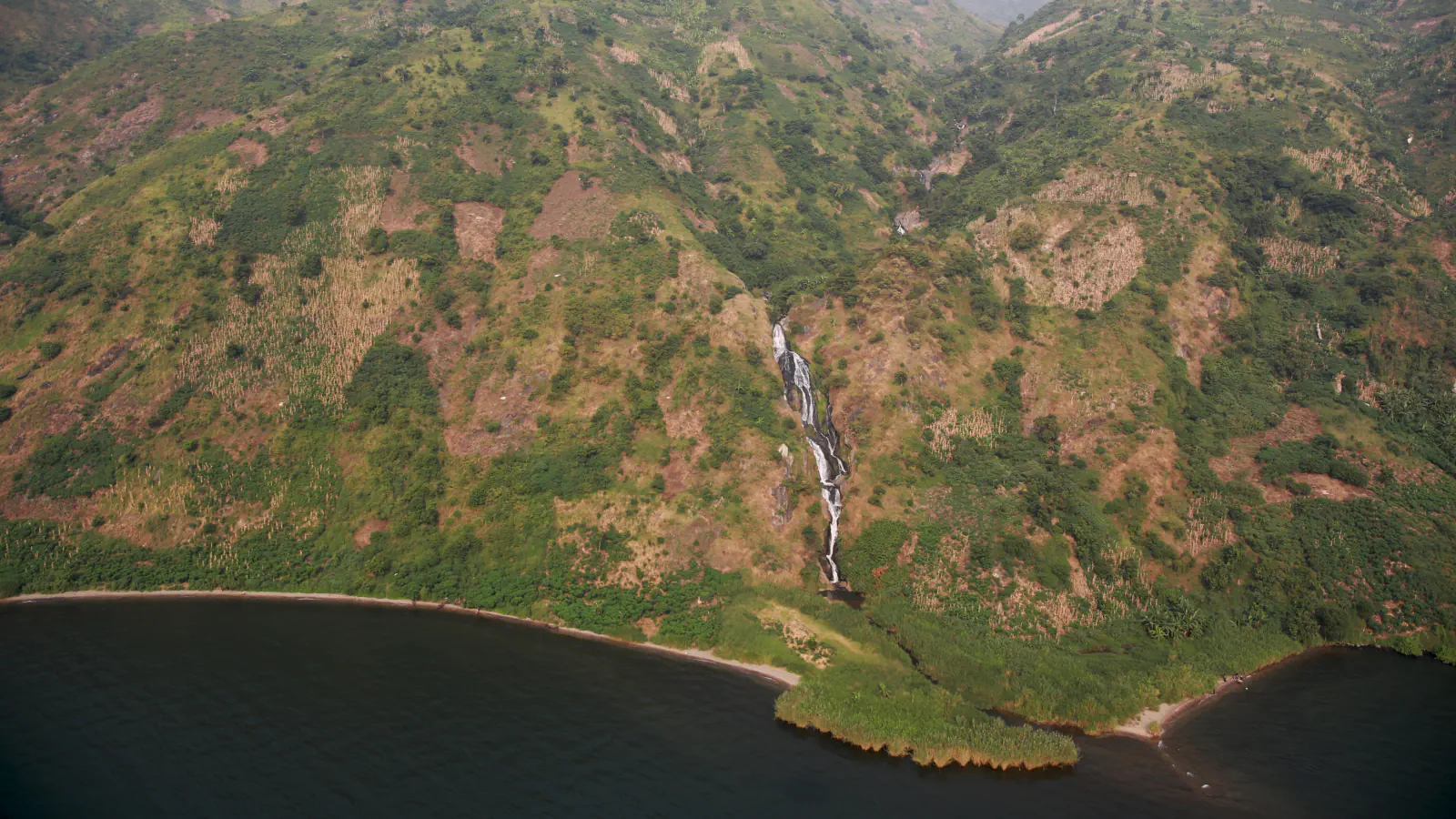
Ishango lies in the north-east of the country, in Virunga National Park, on the Congolese bank of Lake Edward; UNESCO names the eroded valleys of the Sinda and Ishango regions among the park’s landscapes. According to the Royal Belgian Institute of Natural Sciences, the zoologist Hubert Damas of Liège University came across human bones and bone harpoon heads here in 1935, and the Institute’s geologist Jean de Heinzelin excavated the site in 1950 and 1959. The Institute reports carbon-14 dates showing several layers older than 20,000 years, the oldest 25,000 years, and says that about a hundred human bones from the site come from at least nine people. Among the finds is the Ishango bone: a mammal-bone handle with a fragment of quartz set at one end, carved with 168 parallel marks in groups on three sides. De Heinzelin read the groups as numbers, such as three and six, four and eight, five and ten. The Institute adds that other researchers interpret them differently, and that the mathematician Olivier Keller cautions against projecting a modern habit of seeing numbers everywhere onto the bone.[1][2][3]
Lomami basin: the forest of the lesula
Hart and colleagues (PLoS ONE, 2012) describe Cercopithecus lomamiensis, known locally as the lesula, as a new species. Their field teams first saw one in June 2007, a captive juvenile in the town of Opala, and first observed the species in the wild in December 2007 in the Obenge area. They place it in about 17,000 km² of forest in the eastern central basin, bounded by the Lomami River to the east and the upper Tshuapa River to the west; the specific name acknowledges the Lomami. The paper describes a mane of long grizzled blond hairs around a pale, bare face, and an animal that is semi-terrestrial, with a diet that includes plants growing on the ground. Its nearest relative, Cercopithecus hamlyni, is separated from it by the Congo (Lualaba) and Lomami rivers. The authors place the lesula in what they call the TL2 region, running from the upper Tshuapa through the Lomami basin to the Lualaba, where they list 11 species or distinctive subspecies of anthropoid primates, four of them found nowhere else.[4]
Kinshasa and Brazzaville: rumba as music, dance and instrument-making
UNESCO’s file on Congolese rumba describes a musical genre and a dance common in urban areas of the Democratic Republic of the Congo and the Republic of the Congo; the Intergovernmental Committee’s decision says it is practised mainly in the cities of Kinshasa and Brazzaville. The dance is generally performed by a male–female couple and originates from an ancient dance called nkumba, meaning ‘waist’ in Kikongo. UNESCO writes that rumba is used for celebration and mourning, in private, public and religious spaces, that women have played a predominant role in developing its religious and romantic styles, and that the heritage includes making traditional and modern instruments. It is passed on through neighbourhood clubs, formal training schools and community organisations, and UNESCO listed it in 2021 as intangible heritage of both countries.[5][6]
Good to know
A few clear answers before you explore.
What is the Ishango bone?
A bone handle about 10 cm long with a fragment of quartz at one end, excavated by the geologist Jean de Heinzelin in 1950 near Ishango on Lake Edward. Its handle carries 168 parallel marks in groups, and interpretations of them differ.[1][2]
Where does the lesula live?
Hart and colleagues report it only from about 17,000 km² of forest in the eastern central basin, between the Lomami River in the east and the upper Tshuapa River in the west. They described it as a new species in 2012.[4]
Where is Congolese rumba practised?
UNESCO says it is common in urban areas of the Democratic Republic of the Congo and the Republic of the Congo, and the Intergovernmental Committee’s decision says mainly in Kinshasa and Brazzaville. It is generally danced by a couple and used for celebration and mourning.[5][6]
The WorldStamped community
Every visit becomes part of a story.
- Members with public visits
- 0
- Places with public visits or memories
- 0
- Public memories
- 0
No public visits have been counted here yet. Add this destination to your own map and choose what you want to share.
Members are counted once. Counts include only eligible public activity from profiles that allow search discovery. Private and followers-only content is excluded.