🇿🇼Country
Granite quarrying at Great Zimbabwe; linseed oil darkened Pomongwe paintings
At Great Zimbabwe, a mason’s 2021 account describes fire-splitting granite for dry-stone walls. At Pomongwe Cave in the Matobo Hills, UNESCO records another intervention: 1920s linseed-oil experiments darkened the paintings.
At a glance
- Fire-setting in a 2021 interview
- A veteran mason described lining firewood along granite cracks, heating the stone, then using a hammer lightly to break it into pieces.[1]
- Pomongwe paintings
- UNESCO attributes their darkening to 1920s experiments using linseed oil as a preservative.[2]
- Wall dimensions at Great Zimbabwe
- Heights of 1 to 12 m and widths of 1 to 5 m, according to Sagiya.[1]
A place worth remembering
Great Zimbabwe: splitting granite for dry-stone walls
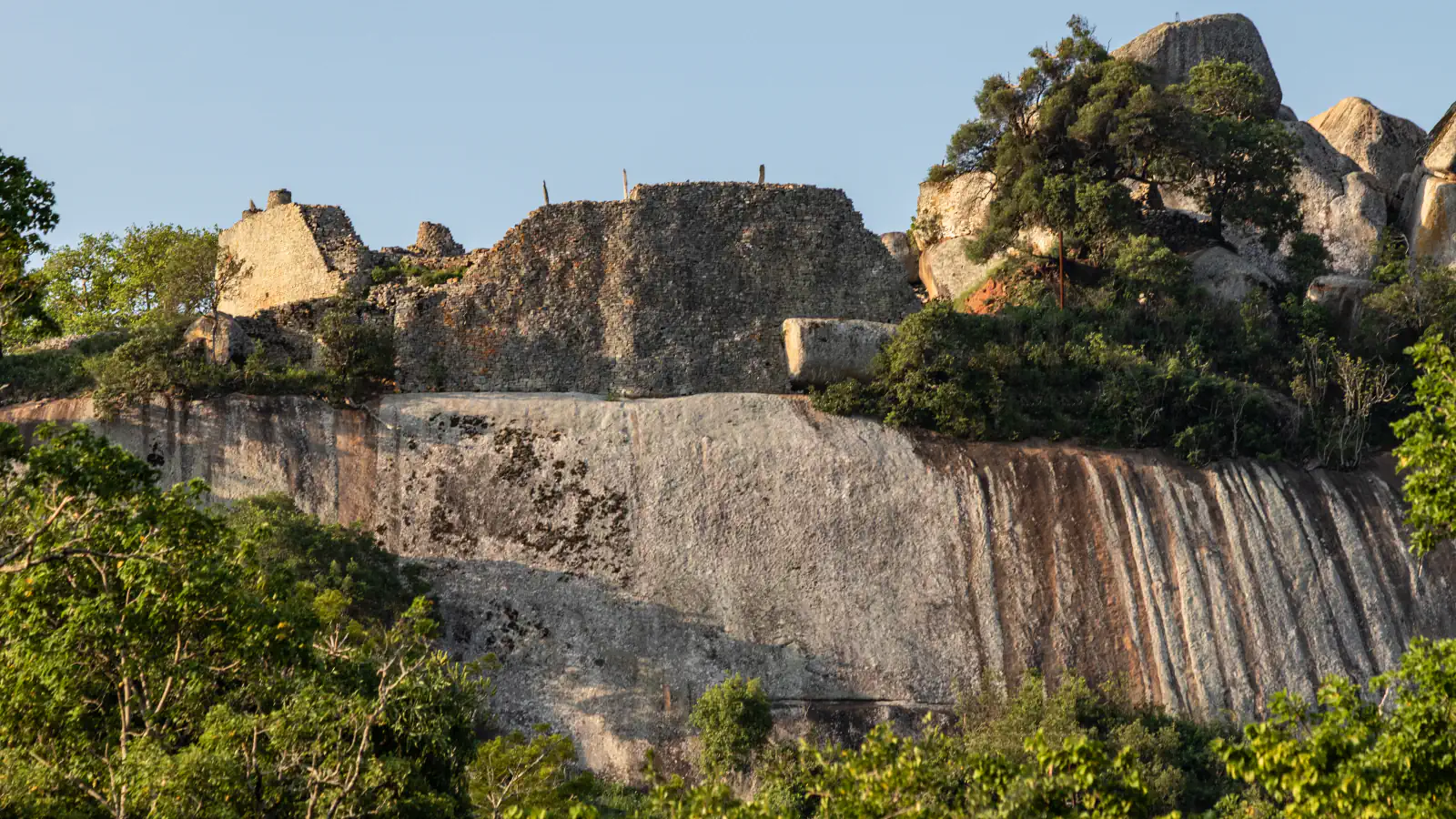
Sagiya describes the freestanding walls as having orderly stone courses on two outer faces, with stones of less regular shapes filling the core. A 2021 field interview records a mason choosing cracked granite, lining firewood to match the intended block size, and heating the stone until it splits.[1]
Pomongwe: a preservative that darkened paintings
UNESCO attributes the darkened images at Pomongwe Cave to tests of a linseed-oil treatment in the 1920s.[2]
How high the dry-stone walls rise
Sagiya reports that Great Zimbabwe’s dry-stone walls are built from biotite granite, quarried from bedrock outcrops in the surrounding area. They range from 1 to 12 m in height and from 1 to 5 m in width, and freestanding walls predominate.[1]
Good to know
A few clear answers before you explore.
How did a mason describe splitting granite at Great Zimbabwe?
In field notes from 2021, a veteran mason says he matched the firewood to a block’s intended size, heated cracked granite, then used a hammer lightly to break the stone into pieces.[1]
How does UNESCO explain the darkened Pomongwe paintings?
UNESCO links their appearance to linseed-oil preservation experiments in the 1920s.[2]
How large are the walls of Great Zimbabwe?
Sagiya gives heights of 1 to 12 m and widths of 1 to 5 m, with freestanding walls predominating.[1]
The WorldStamped community
Every visit becomes part of a story.
- Members with public visits
- 0
- Places with public visits or memories
- 0
- Public memories
- 0
No public visits have been counted here yet. Add this destination to your own map and choose what you want to share.
Members are counted once. Counts include only eligible public activity from profiles that allow search discovery. Private and followers-only content is excluded.