🇿🇲Country
A migrating waterfall cuts basalt gorges; at Kalambo, a notched log joins a larger trunk
At Victoria Falls, IUGS describes a westward-moving break in the river profile. At Kalambo, researchers interpret a notch in one log as a joint through which a larger trunk passes.

At a glance
- Victoria Falls geology
- IUGS describes the falls as the current position of a westward-migrating knickpoint cutting lower gorges into Jurassic basalt.[1]
- Kalambo Falls dating
- Luminescence dating places the lowest wood-bearing layers at least 476 ± 23 thousand years ago.[2]
- Further Kalambo wood tools
- Four tools dated to 390–324 thousand years ago.[2]
A place worth remembering
Victoria Falls: a migrating break in layered basalt
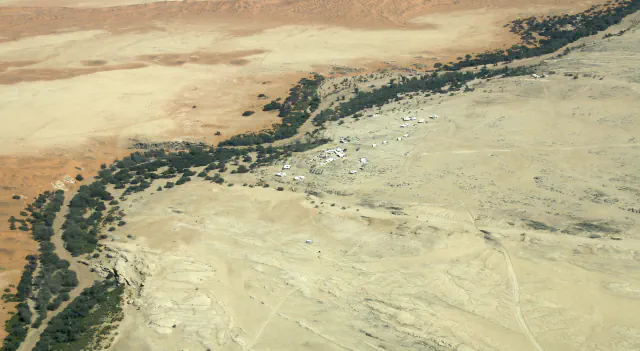
IUGS places Victoria Falls at the current westward-moving knickpoint in the river. The sharp change in gradient has carved narrow, steep downstream gorges in Jurassic bedrock, while the channel above the falls is wide and gently sloping.[1]
Kalambo Falls: a notch joining two logs
A 2019 excavation at Kalambo recovered wood from waterlogged river deposits. Barham and colleagues’ 2023 study dated 16 sand samples bracketing the finds; the lowest layers containing wood are at least 476 ± 23 thousand years old. They describe an upper log, object 1033, with shaping marks around a notch; a modified trunk left in place passes through it. The authors interpret the worked notch as an intentional joint, while noting that wood can also be carried naturally into these deposits.[2]
Four more wood tools from Kalambo
The 2023 study also reports four further wood tools from Kalambo dated to between 390 and 324 thousand years ago, including a digging stick, a cut log and a notched branch. The authors see in them an earlier-than-expected range of shapes.[2]
Good to know
A few clear answers before you explore.
What carved the gorges below Victoria Falls?
IUGS interprets the falls as a knickpoint that migrates west. Downstream, the river has carved steep-sided cuts into Jurassic basalt; upstream, it occupies a much wider, more gently sloping channel.[1]
How do the Kalambo logs fit together?
The modified lower trunk passes through a notch in upper log 1033. The researchers interpret the shaping as deliberate work to join the two pieces; the reported age is for wood-bearing deposits, not a direct date for the log itself.[2]
What other worked wood did the Kalambo team report?
Four tools from 390 to 324 thousand years ago: among them a digging stick, a cut log and a notched branch.[2]
The WorldStamped community
Every visit becomes part of a story.
- Members with public visits
- 0
- Places with public visits or memories
- 0
- Public memories
- 0
No public visits have been counted here yet. Add this destination to your own map and choose what you want to share.
Members are counted once. Counts include only eligible public activity from profiles that allow search discovery. Private and followers-only content is excluded.