City
Gingerbread timber, a restored iron market and bronze
In Port-au-Prince, the World Monuments Fund (WMF) report describes gingerbread houses where timber and masonry work together; the Marché en Fer preserves part of its iron frame, while Le Marron Inconnu is a bronze at Champ de Mars.
At a glance
A place worth remembering
Gingerbread houses combine timber and masonry
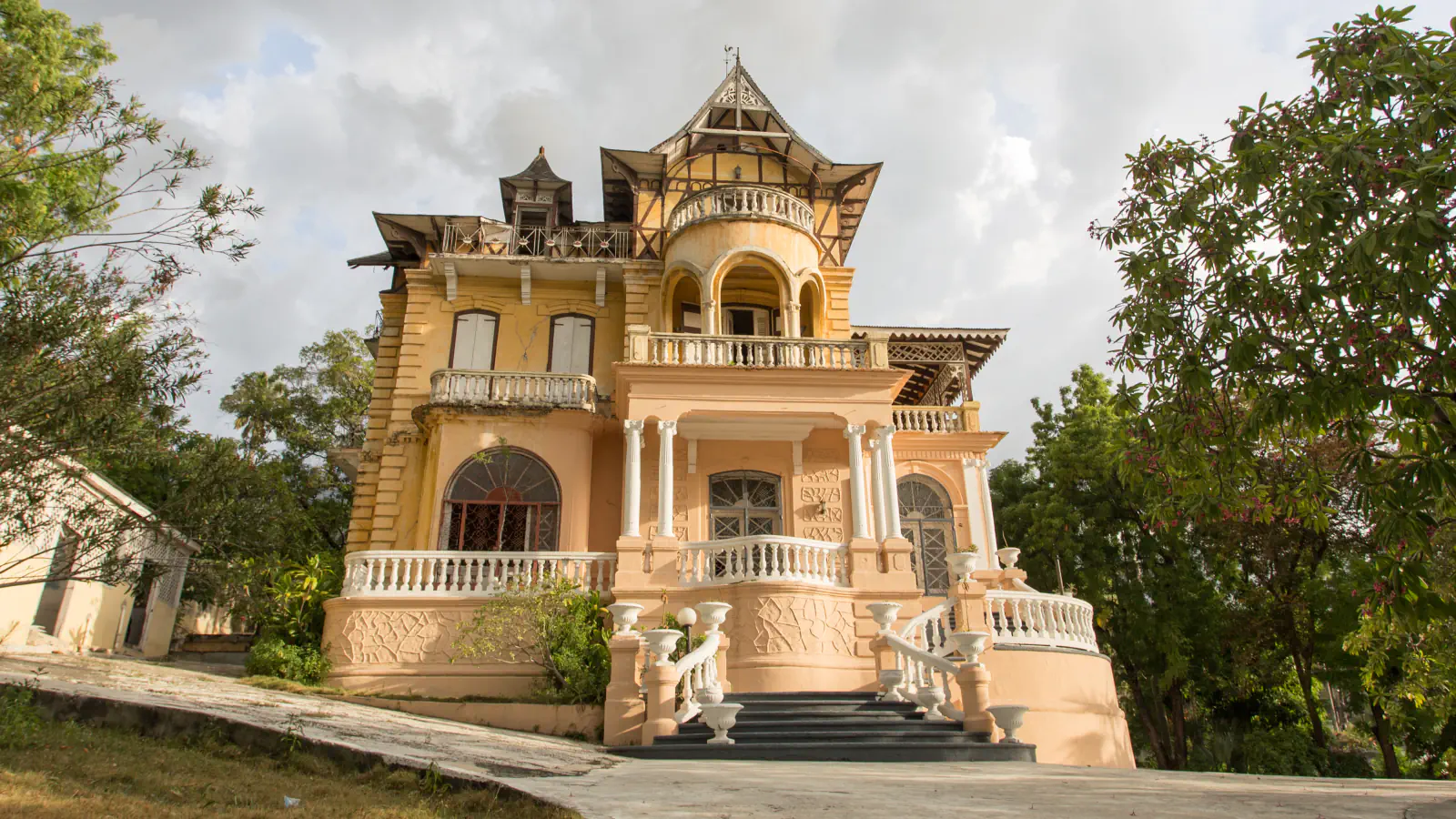
The WMF report treats these houses as mixed structures rather than one uniform style: braced timber framing, colombage infill and bearing masonry can meet within a single building. In some rubble-filled bays, the report notes, barbed wire was fixed to the frame; assembly marks led its authors to suggest that some frames may have been prefabricated. The report says the largest concentration of these houses lies in an area of about 1.5 km² south-east of downtown, covering five neighbourhoods including Pacot. Visit Haiti identifies the pictured house as Villa Miramar, also called Cordasco House, in Pacot.[1][2]
Marché en Fer: two halls with different repair histories
John McAslan + Partners says the two halls were fabricated in Paris and assembled in Haiti in 1891. After a 2008 fire and the 2010 earthquake, the north hall was rebuilt in standard steel; Architectural Record reports that most of the south hall’s original iron frame was retained. The market reopened in January 2011.[3][4]
Le Marron Inconnu at Champ de Mars
The Contemporary Monuments to the Slave Past database identifies Le Marron Inconnu, also titled Nèg Mawon, as a bronze by Albert Mangonès dated 22 September 1967. It describes a kneeling figure with a broken chain at his foot, a conch shell held to his lips and a machete in his other hand. The entry says the statue was made in memory of the end of slavery in Haiti.[5]
Good to know
A few clear answers before you explore.
How does the WMF report describe gingerbread construction?
It describes timber framing and masonry as systems that were often combined. In some colombage walls, rubble infill was reinforced with barbed wire fixed to the frame.[1]
How much of the Marché en Fer’s original iron frame remains?
Architectural Record says most of the south hall’s original frame was preserved; the north hall was rebuilt in standard steel after the fire and earthquake.[3][4]
What does Le Marron Inconnu commemorate?
The Contemporary Monuments to the Slave Past database says the statue was made in memory of the end of slavery in Haiti.[5]
The WorldStamped community
Every visit becomes part of a story.
- Members with public visits
- 0
- Places with public visits or memories
- 0
- Public memories
- 0
No public visits have been counted here yet. Add this destination to your own map and choose what you want to share.
Members are counted once. Counts include only eligible public activity from profiles that allow search discovery. Private and followers-only content is excluded.