🇭🇹Country
Haiti: Citadelle’s cisterns, Lake Miragoâne’s record and E. amadeus
UNESCO places Citadelle Henry on Pic Laferrière, gives 970 m as the height to which it was constructed, and notes waterworks and cisterns within the fort. A 1999 Lake Miragoâne study uses its 7.6 m sediment core to compare pollen evidence of vegetation with oxygen isotopes tracking water balance. IUCN’s 2011 account reports six frog rediscoveries during a 2010 search in Haiti’s southwest mountains.
At a glance
A place worth remembering
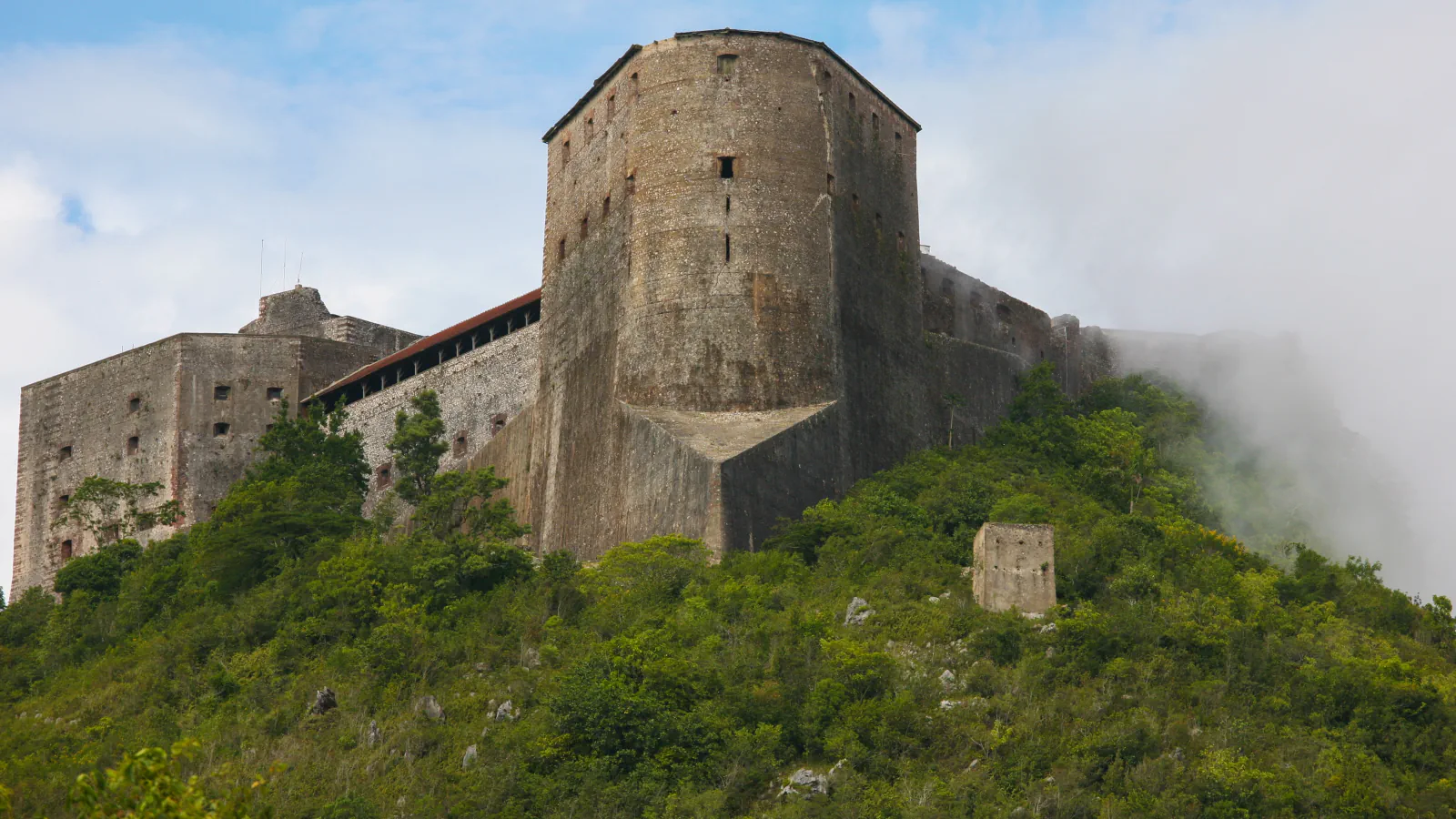
Citadelle Henry: a fortress with built water storage
Citadelle Henry stands on Pic Laferrière; UNESCO gives the height of the construction as 970 m. UNESCO’s entry notes the fort’s waterworks and cistern storage alongside its courtyard and defensive walls. The same passage also mentions batteries and barracks on several levels.[1]
Lake Miragoâne: two records from one sediment core
In their 1999 paper, Higuera-Gundy and colleagues interpret oxygen isotopes as a record of changing evaporation relative to precipitation, while pollen tracks vegetation. The abstract describes the middle Holocene, about 7,000–3,200 radiocarbon years before present, as a high-water interval with a stronger moist-forest pollen signal. These ages are radiocarbon years, not calendar dates.[2]
Southwest Haiti: six frog rediscoveries reported in 2011
An IUCN release from January 2011 reports six frog rediscoveries during a search in Haiti’s southwest mountains in October 2010. The release is a dated account of that expedition; it does not provide a current population update.[3]
Good to know
A few clear answers before you explore.
What does UNESCO’s entry say about Citadelle’s waterworks?
It notes water infrastructure and cistern storage among the fort’s features. The listing describes the site; it does not establish which parts remain operational today.[1]
How do pollen and oxygen isotopes complement each other?
The abstract treats oxygen isotopes as evidence of shifts in evaporation relative to precipitation, while pollen records changing vegetation. Read together, the two indicators connect lake conditions with changes in the surrounding plant record.[2]
Why is E. amadeus associated with Mozart?
The 2011 release traces the association to Blair Hedges’ reading of the call spectrogram: its plotted pattern suggested music to him.[3]
The WorldStamped community
Every visit becomes part of a story.
- Members with public visits
- 0
- Places with public visits or memories
- 0
- Public memories
- 0
No public visits have been counted here yet. Add this destination to your own map and choose what you want to share.
Members are counted once. Counts include only eligible public activity from profiles that allow search discovery. Private and followers-only content is excluded.