🇵🇾Country
Paraguay: eight minutes at Itaipú, two mission ruins and a Chaco salt lake
At 05:45 on 13 October 1982 the gates at Itaipú began to close the Paraná, and eight minutes later the job was done. This page runs from that river border with Brazil to two Jesuit mission ruins in the south and a salt lake in the Chaco, in the west of the country.
At a glance
A place worth remembering
Itaipú: closing a river
Itaipu Binacional was created by a treaty between Brazil and Paraguay signed on 26 April 1973. On 13 October 1982 the final closing of the plant’s 11 gates began, diverting the Paraná; it ended eight minutes later, with the gates shut at 20-second intervals while the river ran at 12,000 m³/s, the highest flow permitted for the closure. In the preceding weeks water had been stored in reservoirs on the Yguazú river so that the Paraná kept a flow of at least 5,000 m³/s at their confluence during the 15 days needed to fill the lake. Itaipú gives the lake as 170 km long with a surface of 1,350 km², of which 780 km² lie in Brazil and 570 km² in Paraguay. Ten of the plant’s 20 generating units run at 50 Hz, Paraguay’s grid frequency, and ten at 60 Hz, Brazil’s. A 2011 Itaipú article on restoring its 250 m physical scale model of the plant, used for studies during construction, places it in the grounds of the Hydraulics Laboratory at Hernandarias.[1][2][3]
Trinidad and Jesús: plazas, arcades and an unfinished church
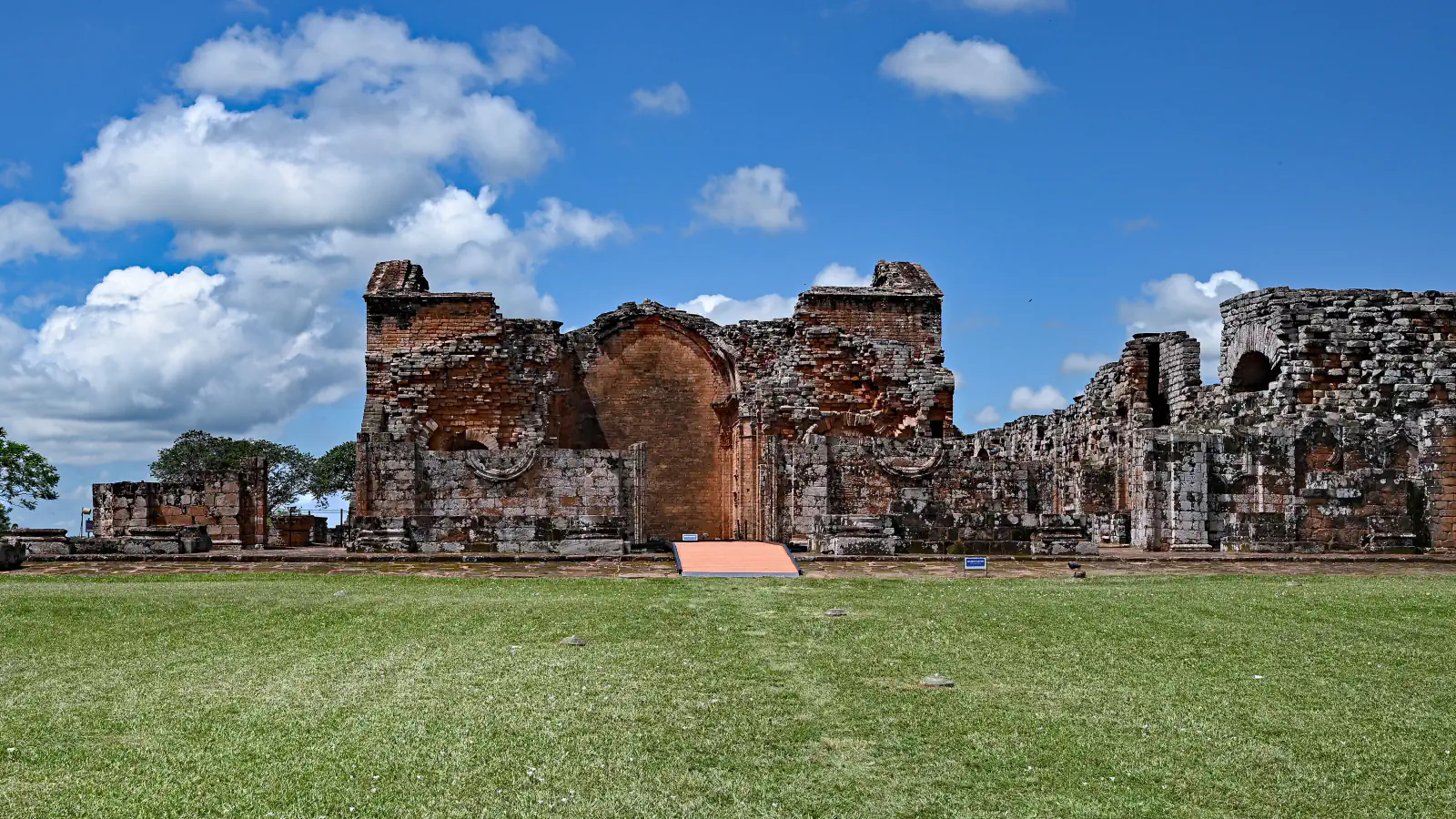
UNESCO counts these two ruined settlements among 30 Jesuit missions of the Río de la Plata basin, seven of them in Paraguay, and says they stand about 10 km apart; its Japanese-language description places them in southern Paraguay near the Argentine border. Each mission centred on a church beside a large plaza facing the four cardinal points, with streets 16 or 18 m wide radiating from the squares and indigenous houses in arcaded blocks 60 m square. La Santísima Trinidad de Paraná was established in 1706 and covers about 8 ha; its large stone church, with a dome, was built around 1745 to a design by the Milanese architect Juan Bautista Prímoli, and work there has followed a survey of the standing remains and an archaeological study of buried evidence. At Jesús de Tavarangue the church remained unfinished and one room of the school survives; UNESCO singles out its trefoil arch as an expression of the Mudéjar (Christian-Arab) style.[4]
Laguna Chaco Lodge: a salt lake that follows the rain
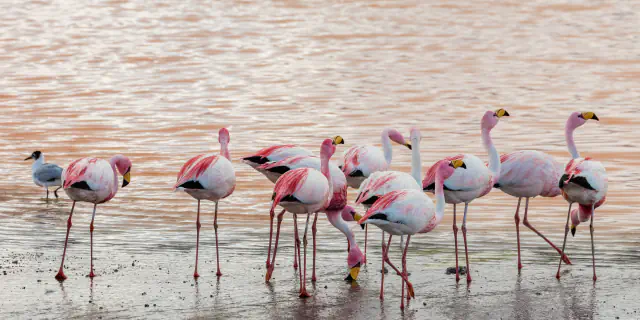
In Presidente Hayes department, about 80 km south-east of Loma Plata on the access road to Puerto Casado, the Laguna Chaco Lodge Ramsar site was designated on 20 October 2003. It covers 2,500 ha of private reserve around a natural saline lagoon of 500 ha. The Ramsar information sheet says the lake’s salinity depends partly on rainfall: in the rainy summer the water rises and salt concentration falls for a time, while in dry periods salt crystallises on the ground surface (it cites Mereles and colleagues, 2002). A 1999 rapid ecological assessment recorded 204 bird species, and the sheet lists counts of up to 25,000 Wilson’s phalaropes, 4,000 white-rumped sandpipers and 3,000 pectoral sandpipers, figures it equates with 1 percent of the global populations.[5]
Good to know
A few clear answers before you explore.
How long did it take to close the Paraná at Itaipú?
Itaipú says the closure that began at 05:45 on 13 October 1982 finished eight minutes later, with the 11 gates shut at 20-second intervals. Its notice gives 15 days as the time needed to fill the lake.[1]
What survives at Trinidad and Jesús?
UNESCO calls both archaeological ruins. At Trinidad evidence survives of the main church, a small church, school, cloister, cemeteries, kitchen gardens, belfry, indigenous houses and workshops. At Jesús it lists the unfinished church, the Major Square, one room of the school and houses for orphans and widows known as Coty Guazú.[4]
Is all the water at Laguna Chaco Lodge salty?
No. The lagoon is natural salt water, but the Ramsar sheet also lists artificial freshwater ponds (tajamares), about 100 by 100 m on average, and rain-fed waterholes (aguadas); it says the ponds serve as the freshwater reservoir for the species living there.[5]
The WorldStamped community
Every visit becomes part of a story.
- Members with public visits
- 0
- Places with public visits or memories
- 0
- Public memories
- 0
No public visits have been counted here yet. Add this destination to your own map and choose what you want to share.
Members are counted once. Counts include only eligible public activity from profiles that allow search discovery. Private and followers-only content is excluded.