🇲🇳Country
Mongolia: dinosaur nests, a Karakorum mint and Altai rock art
At Bayanzag, an embryo inside an egg changed the reading of a nest found decades earlier. A silver coin dated 1237/38 is early evidence for Karakorum, while Altai rock-art dates remain stylistic estimates.
At a glance
A place worth remembering
Flaming Cliffs: an egg thief that may have been a parent
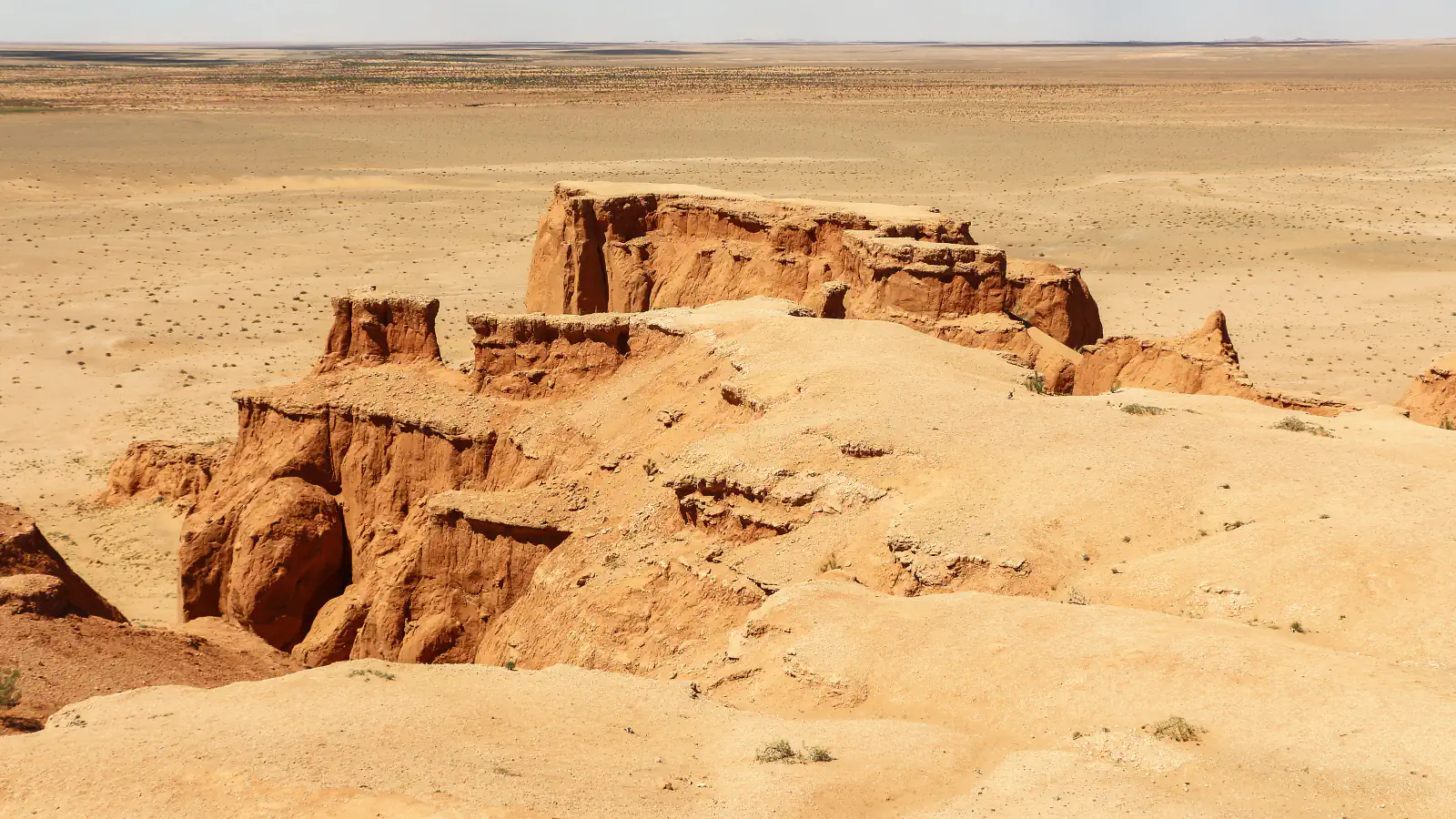
At Bayanzag in the Gobi, Roy Chapman Andrews introduced the English name “Flaming Cliffs” in 1923; the local name refers to the zag shrubs that grow there, according to the Institute for the Study of Mongolian Dinosaurs. The American Museum of Natural History recounts why Oviraptor was once cast as an egg thief: eggs recovered in the 1920s were assigned to Protoceratops, and a skeleton found over a nest seemed to confirm that story. AMNH dates the discovery of a matching egg to 1993. Norell and colleagues’ 1994 Science abstract identifies its embryo as a theropod and says the nest below the Oviraptor holotype may instead show a brooding adult.[1][2][3]
Orkhon Valley: runic stelae and the workshops of Karakorum
At Khosho Tsaidam, two memorials honour Bilge Khan and Kultegin. The 2004 ICOMOS evaluation describes Bilge’s inscribed monument as a stone slab mounted on the back of a sculpted stone turtle; Britannica dates the pair to AD 732 and 735 and credits Vilhelm Thomsen with deciphering their script in 1893. Near modern Kharkhorin, the ruins of Karakorum preserve a different record of Mongol rule. Bonn archaeologists excavated its centre from 1999 to 2005, uncovering workshops along a paved north–south street. Finds include a silver coin bearing a Karakorum mint stamp, dated 1237/38, and a bronze finance-ministry seal of 1371/72. UNESCO also includes Erdene Zuu, Tuvkhun and Shankh Western monasteries in its account of the Orkhon landscape’s continuing religious traditions.[4][5][6][7][8]
Mongolian Altai: rock art whose dates rest on style
All three complexes are in Bayan-Ulgii Province. ICOMOS places Aral Tolgoi and Upper Tsagaan Gol in Tsengel soum, and Tsagaan Salaa-Baga Oigor in Ulaankhus soum. UNESCO describes a long sequence of animal imagery—from mammoths, rhinoceroses and ostriches to elk, aurochs and ibex—followed by scenes of herding and horse-based nomadism across roughly 12,000 years. ICOMOS cautions that the proposed dates rely on stylistic comparison and lack independent confirmation. ICOMOS reports some 300 images at Aral Tolgoi, a site of 200 hectares, most of them on horizontal ground that is easy to walk on.[9][10]
Good to know
A few clear answers before you explore.
Was Oviraptor really stealing eggs?
AMNH dates the matching Flaming Cliffs egg discovery to 1993. Norell et al.’s 1994 abstract identifies the embryo as a theropod; they say the nest discovered in 1923 beneath the Oviraptor holotype may indicate brooding, not egg theft.[2][3]
What did the Karakorum excavations find in the city centre?
Bonn’s excavations brought to light workshops beside a paved north–south street, plus a silver coin with a Karakorum mint stamp, dated 1237/38, and a bronze finance-ministry seal of 1371/72. The German Archaeological Institute says the road fell into disrepair after the city declined in the 14th century.[7][8]
How are the Altai carvings dated?
UNESCO presents imagery across roughly 12,000 years. ICOMOS says the assigned dates rely on style without independent confirmation; it suggests that excavation at Tsagaan Gol could reveal older artefacts, a possibility rather than a reported find.[9][10]
The WorldStamped community
Every visit becomes part of a story.
- Members with public visits
- 0
- Places with public visits or memories
- 0
- Public memories
- 0
No public visits have been counted here yet. Add this destination to your own map and choose what you want to share.
Members are counted once. Counts include only eligible public activity from profiles that allow search discovery. Private and followers-only content is excluded.