🇨🇳Country
China: Qin burial pits, a river weir and the Great Wall
Terracotta fragments found while farmers dug a well at Xiyang in 1974 led archaeologists to Pit 1; the museum dates discoveries of Pits 2 and 3 to 1976. Dujiangyan still routes the Minjiang toward Chengdu, while UNESCO’s Great Wall entry traces the defensive system from Hebei to Gansu.
At a glance
A place worth remembering
Shaanxi: discoveries at the Qin burial pits
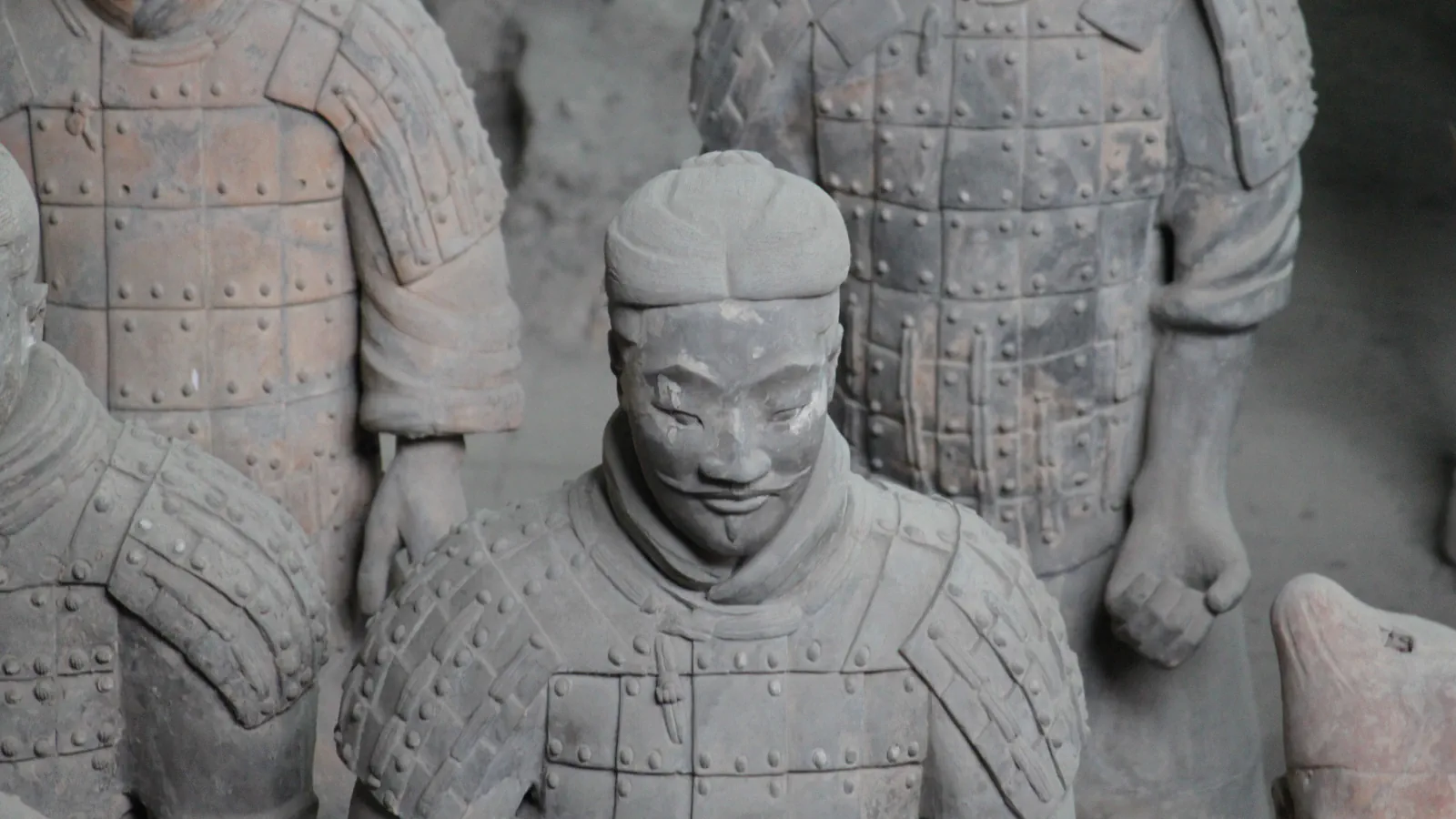
UNESCO dates construction of the emperor’s tomb to 246 BCE, before the burial pits were found. The museum’s account begins with farmers who came across terracotta fragments while digging a well at Xiyang in March 1974; archaeologists then needed more than a year to confirm Pit 1. The museum estimates roughly 6,000 terracotta figures and horses together in Pit 1. It records two further finds in 1976: Pit 2 in April and Pit 3 in May.[1][2][3][4]
Sichuan: how Dujiangyan directs a river
UNESCO dates the original construction of Dujiangyan to around 256 BCE and says the system still distributes Minjiang water to the Chengdu plain. According to the ICOMOS evaluation, the Yuzui Bypass Dike uses a bend in the river to sort the flow: the upper water, which holds little silt, is sent down the Inner Canal, and the muddier layer beneath it down the Outer Canal. UNESCO describes the wider works as using natural terrain to manage irrigation, sediment and floods without dams; its listing gives 668,700 hectares as the irrigated area.[5][6]
The Great Wall from Hebei to Gansu
UNESCO identifies Shanhaiguan in Hebei as the eastern end of the listed wall system and Jiayuguan in Gansu as its western end. Its entry dates construction across successive imperial periods from the 3rd century BCE through the 17th century CE, and includes associated fortresses and passes as well as the wall sections.[7]
Good to know
A few clear answers before you explore.
What role has been suggested for Pit 3?
The museum counts 72 pieces in Pit 3, comprising terracotta figures and horses. It notes that some scholars interpret the pit’s layout as a command post for Pits 1 and 2; that role is an interpretation, not a certainty.[4]
How does the Feishayan gate handle excess flow?
The ICOMOS evaluation describes two modes: at high flow, Feishayan diverts surplus water and carried sediment from the Inner Canal toward the Outer; when the inner flow is low, the gate returns water toward the weir works to maintain irrigation supply.[6]
Which wall-building materials does UNESCO mention?
In Gansu, the UNESCO entry notes a Western Han defence section built from compacted earth. It also cites masonry from the Ming period (1368–1644).[7]
The WorldStamped community
Every visit becomes part of a story.
- Members with public visits
- 0
- Places with public visits or memories
- 0
- Public memories
- 0
No public visits have been counted here yet. Add this destination to your own map and choose what you want to share.
Members are counted once. Counts include only eligible public activity from profiles that allow search discovery. Private and followers-only content is excluded.