🇲🇻Country
Maldives: coral building in Malé and two reef studies
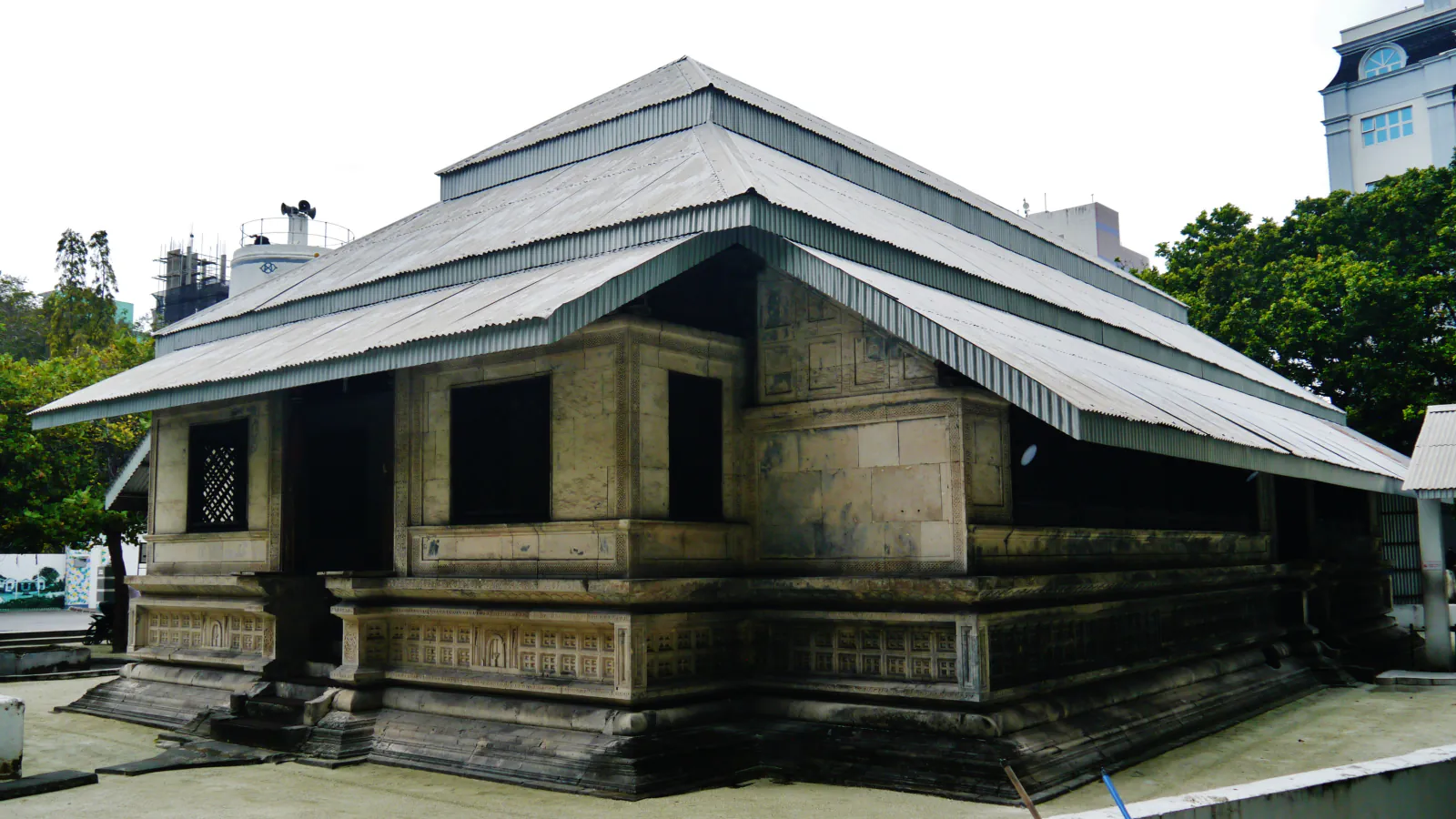
Malé’s Friday Mosque shows coral used as building stone. At Hanifaru Bay, reef shape and tides concentrate plankton; a separate study compared five shallow Gaafu Dhaalu reef sites before and after the 2016 warming event.
At a glance
- Modelled feeding threshold in the 2021 Hanifaru study
- Estimated critical prey density: 53.7 mg dry mass of zooplankton per cubic metre (modelled feeding proportion 0.5).[4]
- Reef growth potential in Gaafu Dhaalu, 2016
- Estimated mean reef-growth potential: 4.2 mm/year before bleaching; −0.4 mm/year afterward.[5]
- Malé Friday Mosque
- The 1658 date marks the mosque’s completion; the entry dates its minaret to 1674 and identifies coral stone as the main building material.[1]
A place worth remembering
Malé: coral stone shaped for a mosque
The Maldives’ 2013 UNESCO Tentative List submission dates Malé’s present Friday Mosque to 1658. It replaced an earlier building, with shaped coral stone and carved timber defining the complex; the entry dates the minaret to 1674.[1]
Hanifaru Bay: currents concentrate prey
The IUCN factsheet describes Hanifaru as a reef inlet on Baa Atoll’s eastern edge. During the southwest monsoon, strong lunar tides can push against the prevailing current and draw plankton-rich water through the channel, while the inlet’s shape traps it. In their 2021 study, Armstrong and colleagues modelled feeding against zooplankton density; their estimated critical threshold was 53.7 mg dry mass per cubic metre, where the modelled proportion of feeding observations reached 0.5.[3][4]
Gaafu Dhaalu: shallow reefs shifted toward erosion
Perry and Morgan measured coral production and bioerosion on fore-reef slopes at 2 m across five locations inside Gaafu Dhaalu Atoll, in January and September 2016. From these biological carbonate-budget measurements, they estimated that mean reef-growth potential shifted from 4.2 to −0.4 mm per year after bleaching. This is a study estimate of growth potential, not a direct measurement of upward reef-surface movement.[5]
Good to know
A few clear answers before you explore.
How do the reef studies differ?
The Hanifaru work links prey concentration to feeding behaviour, whereas the Gaafu Dhaalu study compares shallow-reef carbonate growth before and after the 2016 warming event.[4][5]
What does the IUCN factsheet mean by cyclone feeding?
The factsheet reports a rotating circle of rays that draws plankton-rich water inward; observations included groups of as many as 150 rays and events lasting up to 30 minutes.[3]
What is the Friday Mosque’s UNESCO status?
The UNESCO country page lists no inscribed properties. Its 2013 submission names Malé’s Friday Mosque within a proposed serial group of coral-stone mosques; a Tentative List entry is a State Party’s inventory of properties it may consider for nomination.[2][1]
The WorldStamped community
Every visit becomes part of a story.
- Members with public visits
- 0
- Places with public visits or memories
- 0
- Public memories
- 0
No public visits have been counted here yet. Add this destination to your own map and choose what you want to share.
Members are counted once. Counts include only eligible public activity from profiles that allow search discovery. Private and followers-only content is excluded.