City
Gaborone: a dam, Kgale Hill and a buried Stone Age site
Gaborone’s reservoir entered service in 1964, when the settlement had about 4,000 residents and its plan allowed for 20,000. Construction at Kgale View later uncovered a buried Stone Age assemblage. The National Museum followed Alec Campbell’s proposal in 1966 and opened in 1968.
At a glance
A place worth remembering
A dam for a town that quickly outgrew its plan
A 2018 account says Gaborone had about 4,000 residents when its dam entered service in 1964; the original plan allowed for 20,000, a limit exceeded by the mid-1970s. The authors describe the 2014–15 shortage through several pressures: drought, growing demand, water losses and limited natural inflows. They argue that small upstream farm dams are one part of the picture, not a complete explanation. The wall was raised in 1985 after severe southern droughts, and the 360 km Letsibogo–Gaborone pipeline was completed in 2000. Botswana Daily News reported a sharp swing: only 1.3% of capacity remained in February 2015, while heavy rain had filled the reservoir and caused it to spill by late February 2017.[1][2]
Stone tools beneath Kgale View
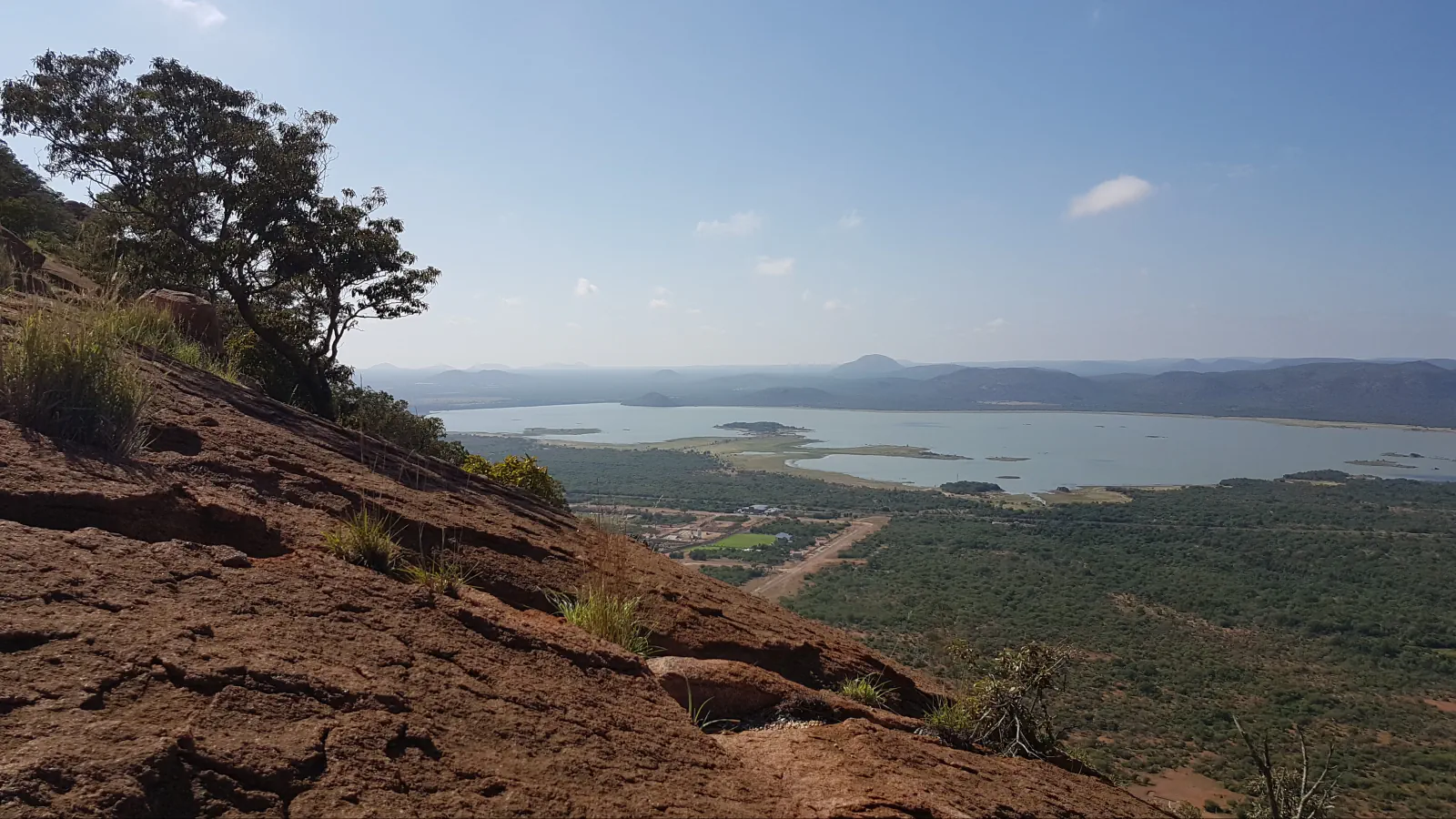
Kgale Hill is a granite landmark on Gaborone’s southern edge, rising 1,287 m above sea level. Building Game City in 2001–02 cut into buried archaeological deposits at Kgale View; salvage work collected 77 artefacts in situ from an exposed profile, with finds lying 1–3 m beneath the former surface; more came from trenches and spoil heaps. The authors think more deeply buried material is likely to remain under the complex. Three sediment samples gave results of 143,537 ± 24,487, 34,289 ± 4,130 and 32,434 ± 3,376 years BP. The artefacts’ pre-burial history cannot be established: the authors note that the duration of surface exposure, and any later re-exposure, is unknown. They therefore treat the dated results as minimum ages for the artefacts. They suggest that sediment accumulation may extend back nearly 150,000 years. They note that most handaxes are fragments and argue that most were deliberately broken, while saying more research is needed on how the tools were used and re-used.[3]
A museum founded through a local partnership
Alec Campbell proposed a museum in 1966; Kgosi Bathoen II chaired the museum’s founding board, and Campbell, Bathoen and Doreen Nteta shaped its focus on archaeology and natural history under the theme “Man and His Environment.” It opened in 1968. A 2018 anniversary account identifies the three as central to its establishment. Sandy Grant’s chapter, commissioned in 2006, records the collections at that time: 20,000 herbarium specimens, 20,000 archaeological artefacts and more than 8,000 ethnographic objects, alongside art and a library. Walker and Downey note that the museum holds handaxes from the Gaborone Dam site.[4][5][3]
Good to know
A few clear answers before you explore.
Why did the Gaborone Dam run so low in 2014–15?
The 2018 study discusses several pressures, including drought, limited surface water, increasing demand and water losses. It treats small farm dams as one of several contributing factors. Botswana Daily News reported that only 1.3% of capacity remained in February 2015; by late February 2017, rain had filled the reservoir and it was spilling.[1][2]
What do the Kgale View dates tell us?
Three sediment samples yielded thermoluminescence results between 32,434 ± 3,376 and 143,537 ± 24,487 years BP. Because the artefacts’ pre-burial surface history is uncertain, the authors interpret the dates as minimum ages for those objects. They suggest that sediment accumulation may extend back nearly 150,000 years.[3]
What collection sizes did Grant record for the National Museum?
In a chapter commissioned in 2006, Grant listed 20,000 herbarium specimens, 20,000 archaeological artefacts and more than 8,000 ethnographic objects. The chapter also describes an art collection and a library.[4]
The WorldStamped community
Every visit becomes part of a story.
- Members with public visits
- 0
- Places with public visits or memories
- 0
- Public memories
- 0
No public visits have been counted here yet. Add this destination to your own map and choose what you want to share.
Members are counted once. Counts include only eligible public activity from profiles that allow search discovery. Private and followers-only content is excluded.