🇸🇿Country
Eswatini: Lion Cavern, the Lubombo range and ancient gneiss
At Lion Cavern on the Ngwenya Massif, luminescence dating places intensive ochre mining at about 48,000 years ago. Far to the east, basalt and rhyolite layers of the Lubombo range date to the Jurassic and Cretaceous, while archaeologists began excavating the Muti Muti shelter in 2023. A 1988 paper reports zircon ages up to 3.644 billion years in tonalitic orthogneisses of the Ancient Gneiss Complex.
At a glance
- Lion Cavern ochre mining
- About 48,000 years by luminescence dating (2024); earlier radiocarbon estimates reached about 43,000 years BP[1][2]
- Lubombo volcanic rocks
- Massive rhyolite flows over basalt; the rhyolites are thinner north of Eswatini[6]
- Zircon age in the Ancient Gneiss Complex
- Tonalitic orthogneisses up to 3,644 ± 4 Ma (1988)[8]
A place worth remembering
Ngwenya Massif, Hhohho: ochre mined at Lion Cavern
At Lion Cavern, a highveld site on the Ngwenya Massif’s ironstone and hematite deposit, six samples dated by optically stimulated luminescence give an age of about 48,000 years. Excavation records point to four or more prehistoric mining locations on the massif; later industrial mining destroyed Castle Cavern and Castle Quarry. Earlier radiocarbon work at Lion Cavern reported dates to about 43,000 years BP; the higher estimates came from outside the shelter, while lower ones came from near its back wall. MacDonald and colleagues’ statistical comparison assigns one iron-oxide artefact group to Ngwenya outcrops with more than 80% probability: the study records 66 examples at Sibebe and reports this material from Nyonyane, Hlalakahle, Nsangwini, Siphiso and Mlawula. In its 2008 nomination, Eswatini gives the siSwati terms libovu for red pigment and ludumane for a glittering variety, associating their use with historical times; the entry dates the modern iron-ore mine to 1964.[1][2][3]
Lubombo range: volcanics and the Muti Muti shelter
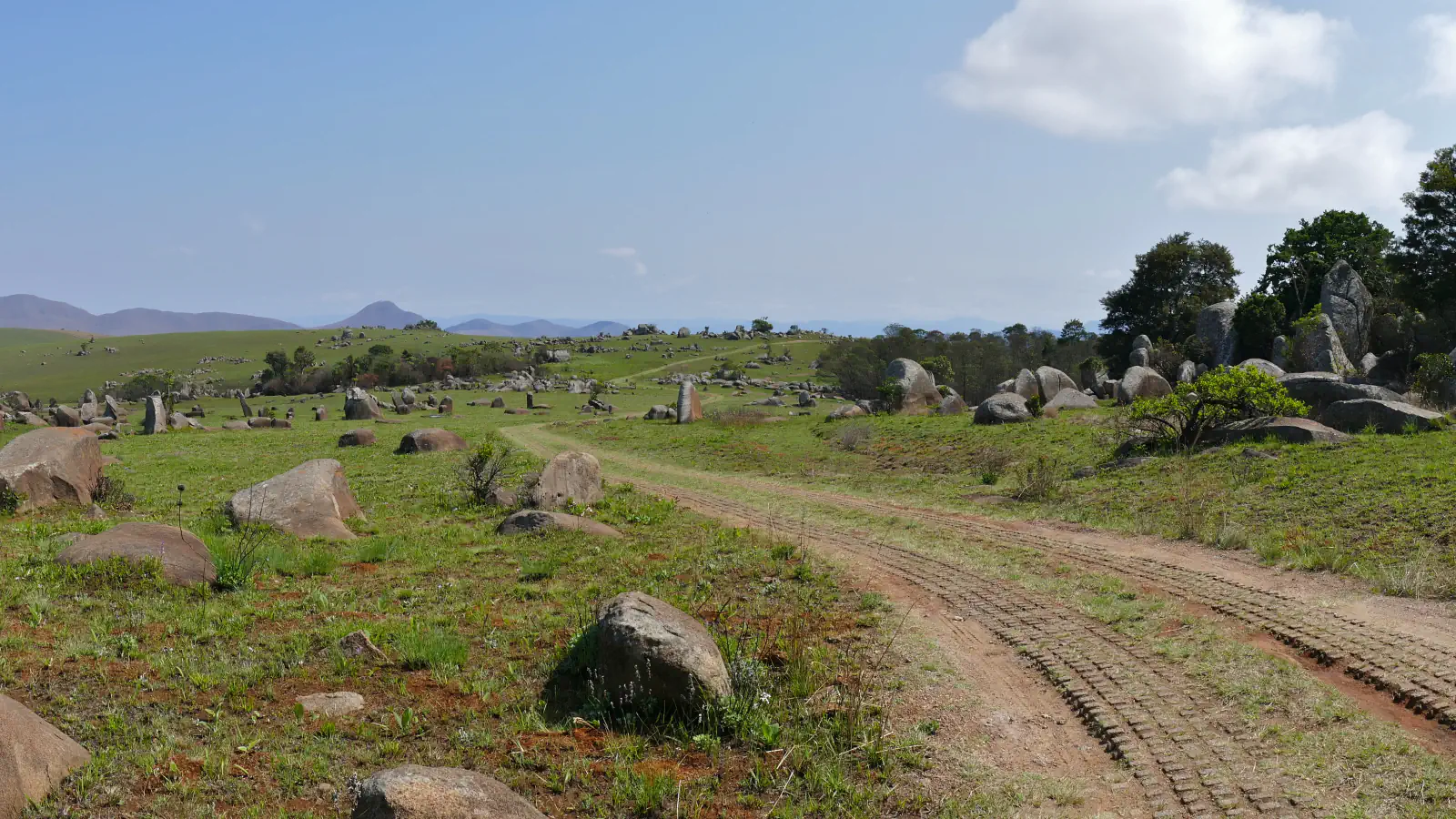
Bristow’s 1980 thesis describes Jurassic–Cretaceous Karoo volcanics along the Lebombo monocline, called Lubombo in Eswatini: basalt is overlain by massive rhyolite flows that are notably thinner north of Eswatini. A team from the German Archaeological Institute and partners, including the Eswatini National Trust Commission, reports that excavations began at Muti Muti shelter in 2023. Surface finds include pottery attributed to Early Farming Communities and stone artefacts that suggest Middle and Later Stone Age occupation. Rock paintings may represent several periods, and pottery was submitted for luminescence dating. MacDonald and colleagues also include Siphiso on the Lubombo range among the stratified Late Stone Age sites in their study.[6][7][1]
Ancient Gneiss Complex: zircons dated to 3.644 billion years
Kröner and Todt’s 1988 paper in the Journal of Geophysical Research reports zircon ages up to 3,644 ± 4 million years in tonalitic orthogneisses of the Ancient Gneiss Complex, adjacent to the Barberton Greenstone Belt.[8]
Good to know
A few clear answers before you explore.
How old is the ochre mining at Lion Cavern?
The 2024 luminescence study reports about 48,000 years from six Lion Cavern deposit samples. The University of Tübingen’s account of earlier excavations gives radiocarbon estimates reaching about 43,000 years BP and says the newer project set out to test those results with luminescence dating.[1][2]
How does the 2024 study use the word “ochre”?
MacDonald and colleagues use the term broadly for earth-derived mineral pigments, including red or yellow iron oxides and iron-rich clay, black pigments and white kaolin. Their paper also notes that Eswatini has more than 50 rock-art sites.[1]
Is there a World Heritage property in Eswatini?
UNESCO’s country record lists no inscribed World Heritage property for Eswatini. Its Tentative List includes Ngwenya Mines, submitted in 2008. A 2023 UNESCO report describes workshops about the possible extension of South Africa’s Barberton Makhonjwa Mountains property into Eswatini.[4][3][5]
The WorldStamped community
Every visit becomes part of a story.
- Members with public visits
- 0
- Places with public visits or memories
- 0
- Public memories
- 0
No public visits have been counted here yet. Add this destination to your own map and choose what you want to share.
Members are counted once. Counts include only eligible public activity from profiles that allow search discovery. Private and followers-only content is excluded.