🇨🇮Country
Côte d’Ivoire: Taï archaeology, Lamto grassland and northern mosques
Researchers interpret evidence from three Taï sites as a record of chimpanzee nut-cracking about 4,300 years ago. At Lamto, the ORNL DAAC estimate for a Loudetia simplex grassland puts 61% of annual net primary production below ground. In the north, UNESCO lists eight earthen mosques and describes how Sudanese-style forms changed as the architecture spread into wetter regions.
At a glance
- Taï archaeological evidence
- At Noulo, the excavation yielded 206 pieces of modified stone; researchers infer chimpanzee nut-cracking roughly 4,300 years ago from the wider three-site evidence.[1]
- Lamto Loudetia simplex grassland
- The annual estimate for the Loudetia simplex grassland is 2,150 g/m², including 1,320 g (61%) below ground.[3]
- Northern mosques
- UNESCO lists eight earthen mosques across seven localities in northern Côte d’Ivoire.[4]
A place worth remembering
Taï: an archaeological inference from stones and starch
UNESCO lists the Taï property at 508,186 hectares in the country’s south-west. At Noulo, the excavation yielded 206 pieces of modified stone. The 2007 study compares stones and plant residues from three archaeological sites with evidence from places where modern chimpanzees crack nuts. Its authors infer that the behaviour occurred in the Taï forest roughly 4,300 years ago, while saying they cannot rule out that some starch reached the stones through redeposition unrelated to use.[2][1]
Lamto: an estimate for Loudetia simplex grassland
For Lamto, ORNL DAAC estimates annual net primary production at 2,150 g/m² in the grassland it identifies as the Loudetia simplex type; 1,320 g (61%) was below ground. This figure concerns that grassland, not the research station as a whole; the documentation notes that published Lamto estimates differ with measurement and calculation methods.[3]
The north: a local form of Sudanese-style architecture
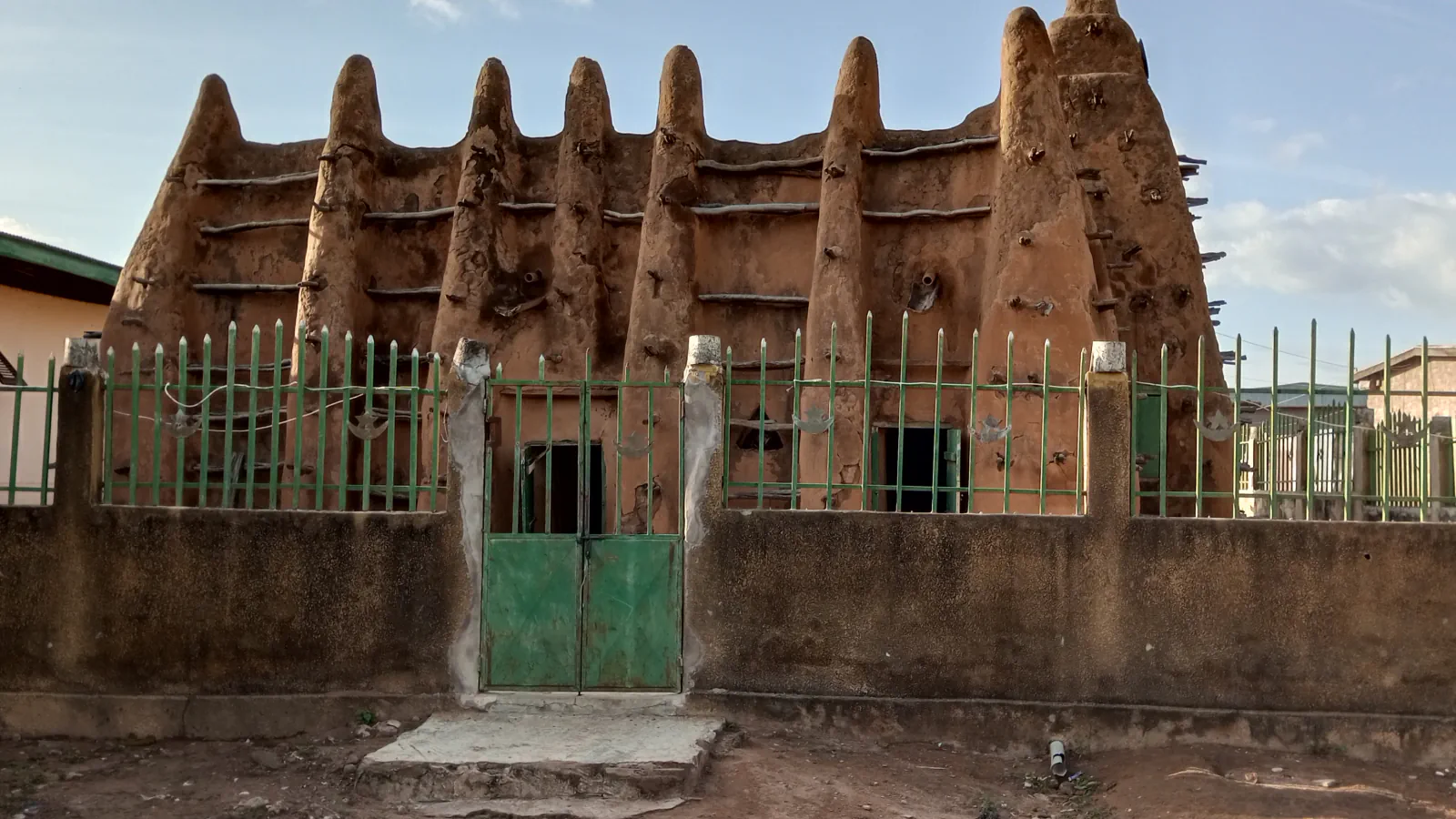
UNESCO lists eight earthen mosques across seven localities in northern Côte d’Ivoire. Their earthen walls, projecting wooden beams and buttresses give a regional expression to Sudanese-style architecture. UNESCO traces the style to Djenné and links the lower forms and stronger supports of its southern spread to wetter conditions.[4]
Good to know
A few clear answers before you explore.
Why do researchers link the Taï stones to chimpanzees?
The paper compares stone forms and plant starch with evidence from modern chimpanzee nut-cracking sites. The authors interpret the combined archaeological evidence as chimpanzee activity, but say they cannot rule out that some starch came from redeposition unrelated to use, such as background starch from roots.[1]
What does Lamto’s 61% figure describe?
It is the below-ground share of estimated annual net primary production for the Loudetia simplex grassland studied at Lamto. It does not represent the whole research station, and the archive notes that published estimates differ partly because methods vary.[3]
How did the Sudanese-style forms change as they spread south?
UNESCO says the forms became lower and the buttresses stronger in wetter regions. That gives a climatic and regional context for the eight northern mosques on its list.[4]
The WorldStamped community
Every visit becomes part of a story.
- Members with public visits
- 0
- Places with public visits or memories
- 0
- Public memories
- 0
No public visits have been counted here yet. Add this destination to your own map and choose what you want to share.
Members are counted once. Counts include only eligible public activity from profiles that allow search discovery. Private and followers-only content is excluded.