City
Brussels, where a river went under the boulevards and a city gate stayed
Boulevard Anspach in central Brussels was laid over the river Senne, which was vaulted between 1867 and 1871 and diverted around the centre by 1955. Three places show the layers: boulevard Anspach above the old vault, the Sewer Museum at Porte d’Anderlecht, and the Halle Gate, a surviving gate of the 14th-century city wall.
At a glance
A place worth remembering
Boulevard Anspach lies on the vaulted Senne
Before 1867 the Senne wound through the lower town in several arms. The plan by Léon Suys, adopted by the city in 1865 and by the state in 1866, vaulted the river over two kilometres, added a brick sewer along each bank and laid straight boulevards 28 m wide above the new channels. The regional heritage inventory counts about 1,100 homes expropriated and demolished, dates the layout of boulevard Anspach to 1867–1871 and says that Mayor Jules Anspach inaugurated the vault in November 1871; the street took his name in 1879. A regional guide gives the day as 30 November 1871 and names the four boulevards of the Y-shaped axis: Lemonnier, Anspach, Adolphe Max and Émile Jacqmain, formerly Hainaut, Central, Nord and Senne.[2][1]
The Sewer Museum at Porte d’Anderlecht
After the vault, the river moved again. The same guide dates the diversion of the Senne along the outer boulevards to 1955 and notes that the emptied channels could hold a metro, with the metro works ending in the late 1970s. The Sewer Museum lies beneath the two former toll pavilions at Porte d’Anderlecht, over a modern collector that the guide describes as passing under the gate. Its website describes a walk along the river Senne and through the main sewer under the Chaussée de Mons.[1][3][4]
The Halle Gate, kept by royal decree
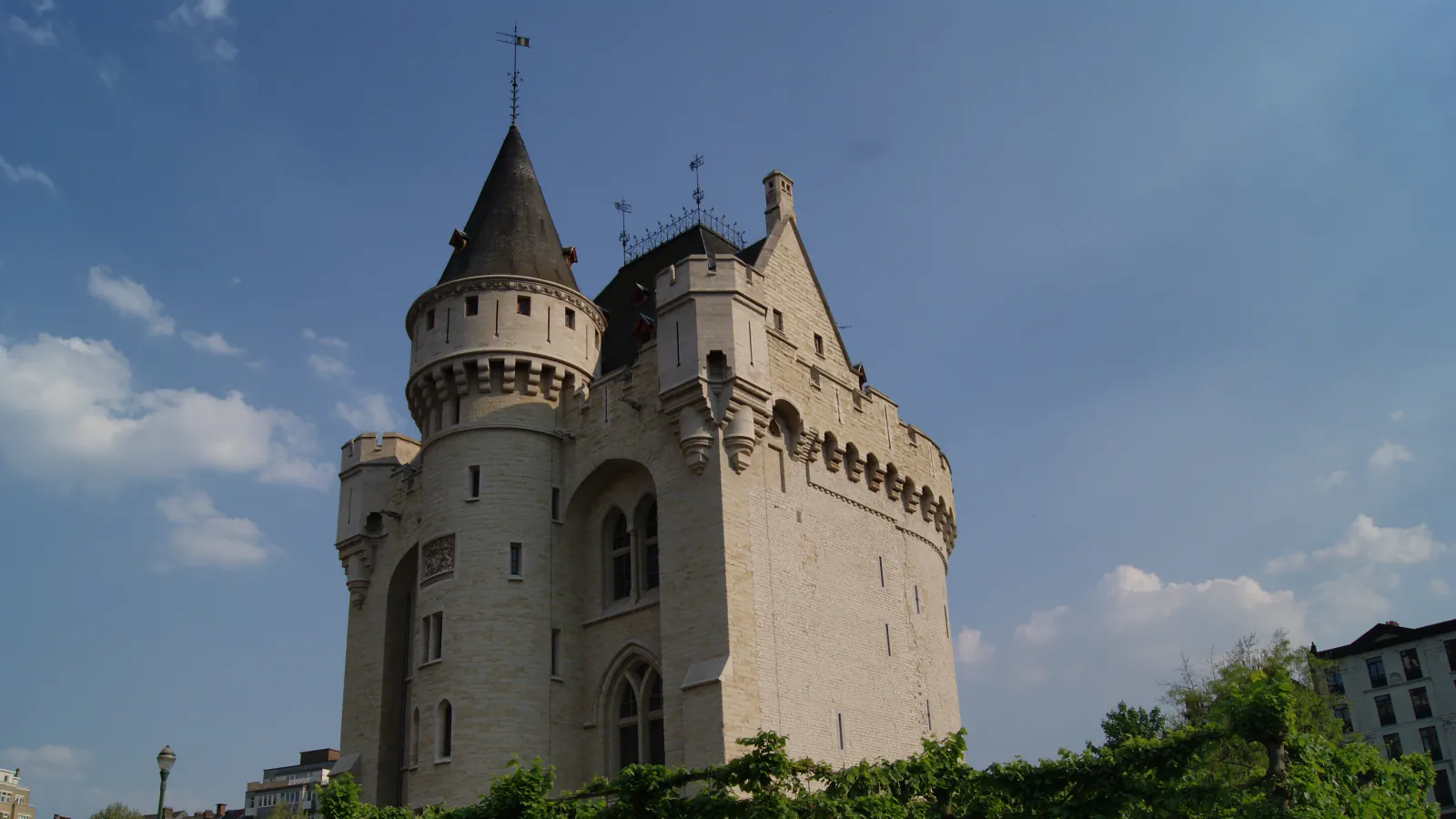
The Halle Gate (Porte de Hal in French, Hallepoort in Dutch), at boulevard du Midi 150, is described by the Brussels-Capital Region’s heritage inventory as the only preserved gate of the city’s second wall. The Royal Museums for Art and History, whose museum now occupies the gate, describe it as one of seven gateways to the fortified city, whose walls stretched for eight kilometres; a regional guide says the wall was begun around 1357 and finished in the south in 1381–1383, and the inventory gives the same years for the gate’s construction. After the ramparts were ordered dismantled in 1782, the gate was again at risk when the city decided to lay a boulevard along the wall’s line. A royal decree of 5 March 1840 ordered it kept, and the city passed it to the state in 1842. The boulevard works raised the ground by about three metres, so the original ground floor is partly buried; the conical-roofed stair tower on the city side comes from Henri Beyaert’s restoration of 1868–1870.[5][6][4]
Good to know
A few clear answers before you explore.
Was cholera the reason the Senne was covered?
A regional heritage guide says unsanitary conditions and floods, not the cholera epidemic of 1866 that a legend blames, pushed the city to act. It adds that vaulting won over cleaning an open river because it combined sanitation with property development.[1]
Where can the Senne be reached today?
The Sewer Museum’s website describes a walk along the river Senne and through the main sewer under the Chaussée de Mons, beneath the two toll houses at Porte d’Anderlecht. It says access can close during heavy rain.[3]
Why does the Halle Gate still stand when the rest of the wall went?
A regional guide says it was spared because it had served as a prison since the Austrian period. The inventory adds the royal decree of 5 March 1840 that ordered its conservation.[4][5]
The WorldStamped community
Every visit becomes part of a story.
- Members with public visits
- 0
- Places with public visits or memories
- 0
- Public memories
- 0
No public visits have been counted here yet. Add this destination to your own map and choose what you want to share.
Members are counted once. Counts include only eligible public activity from profiles that allow search discovery. Private and followers-only content is excluded.