🇦🇿Country
Baku’s old centre, Gobustan engravings and flood-shaped Sheki
Baku’s walled inner city, Gobustan’s rock engravings and Sheki’s rebuilt historic centre offer three distinct ways to explore Azerbaijan’s past.
At a glance
A place worth remembering
Baku: a walled inner city on the Caspian shore
Icherisheher faces the Caspian from the southern part of the Absheron Peninsula. UNESCO notes that much of its 12th-century fortification remains; Britannica adds that the bulk of the walls, which were reinforced following 1806, still stand. Britannica gives the Maiden’s Tower (Kyz-Kalasy) a height of 27 m (90 ft). The Shirvanshahs’ Palace complex occupies the upper part of Icherisheher, UNESCO says, and includes Divankhana, Murad’s Gate, Seyid Yahya Bakuvi’s burial monument and Shah Mosque. UNESCO also dates the neighbouring minaret of Mohammed Mosque to 1078.[1][2]
Gobustan: a rocky plateau with more than 6,000 engravings
The Azerbaijan Tourism Board places Gobustan about 60 km south of Baku near three named peaks: Boyukdash, Kichikdash and Jingirdagh. UNESCO’s 537-hectare landscape is split between three parts of a rocky plateau that stands above the surrounding semi-desert, and the record counts more than 6,000 engravings there. UNESCO interprets the carvings as scenes of hunting and fishing from a period when the climate was warmer and wetter than now. It also notes caves once occupied, settlement remains and burials across a span from the Upper Paleolithic into medieval times. The Tourism Board highlights scenes of animal life, people and warriors, boats, dance, hunting and camel caravans, and mentions nearby mud volcanoes. A separate study, published online in 2008, analysed 12 gas seeps at Azerbaijan’s Dashgil mud volcano and found methane at 94.9–99.6% of the seeping gas; this is a result for those seeps, not a claim about every mud volcano.[4][3][8]
Sheki: a town rebuilt after a flood, and windows of coloured glass
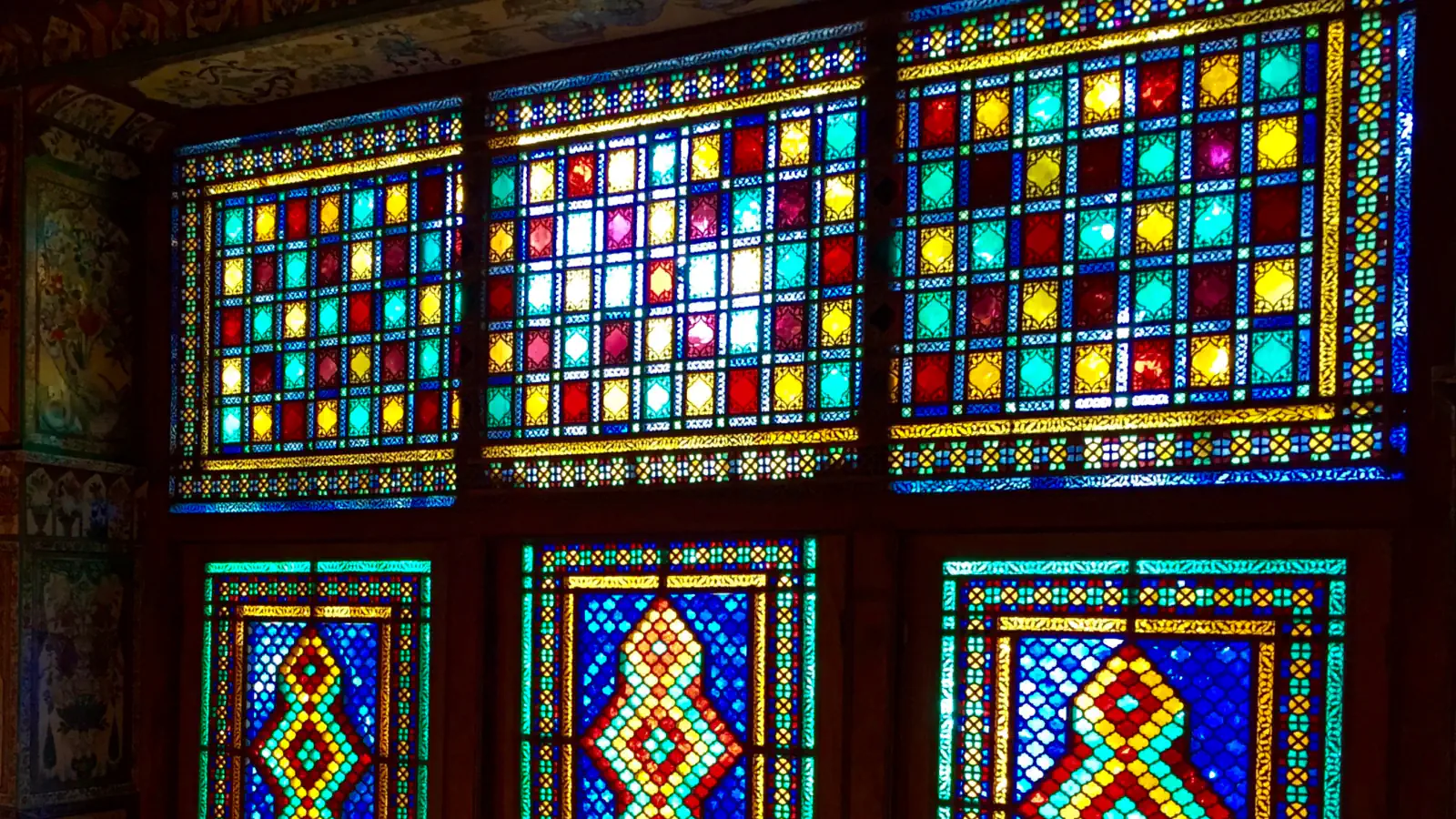
UNESCO places Sheki’s two-part historic core in a valley below the Greater Caucasus, with the Gurjana River between its sides. A mud flood in 1772 destroyed the earlier town; residents rebuilt farther east and uphill, a sequence also described by Saudi Aramco World (2000). UNESCO links high, airy roofs with silkworm breeding in the attics and says the water network distinguished waters by origin: spring, rain and torrent. Aramco World recounts Alexandre Dumas’s comparison of Sheki with Lyon. At the Khan’s Palace, the Tourism Board points to shebeke, an Azerbaijani technique for stained-glass windows made without glue or nails. Aramco World describes rows of latticed windows glazed with Venetian glass running along the palace’s long façade.[5][6][7]
Good to know
A few clear answers before you explore.
What do the Gobustan engravings show?
UNESCO interprets the carvings as evidence of hunting and fishing under conditions warmer and wetter than those of today. Its listing also mentions caves formerly occupied, settlement remains and burial sites from the Upper Paleolithic to medieval times. The Tourism Board points to camel trains, dancing, boats, hunters, animals and human figures among the carved subjects.[3][4]
What happened to Sheki’s older town?
UNESCO says the rebuilt centre stands higher up, in a mountain valley lying to the east of the earlier settlement and beneath the Greater Caucasus. Its description connects the roof forms with silk production in ventilated attics.[5][6]
What is the shebeke technique?
The Azerbaijan Tourism Board describes shebeke as an Azerbaijani technique for stained-glass windows made without glue or nails. Saudi Aramco World describes rows of latticed windows glazed with Venetian glass running along the palace’s long façade.[7][6]
The WorldStamped community
Every visit becomes part of a story.
- Members with public visits
- 0
- Places with public visits or memories
- 0
- Public memories
- 0
No public visits have been counted here yet. Add this destination to your own map and choose what you want to share.
Members are counted once. Counts include only eligible public activity from profiles that allow search discovery. Private and followers-only content is excluded.