🇦🇼Country
Aruba’s Cretaceous geology, rock art and wetlands
Journal articles give two age models for Aruba’s tonalitic rocks; a museum exhibition and an archaeologist’s reported dates trace images at Arikok and Ayo. Ramsar lists two distinct wetland sites.
At a glance
A place worth remembering
Two age models for Aruba’s tonalitic rocks
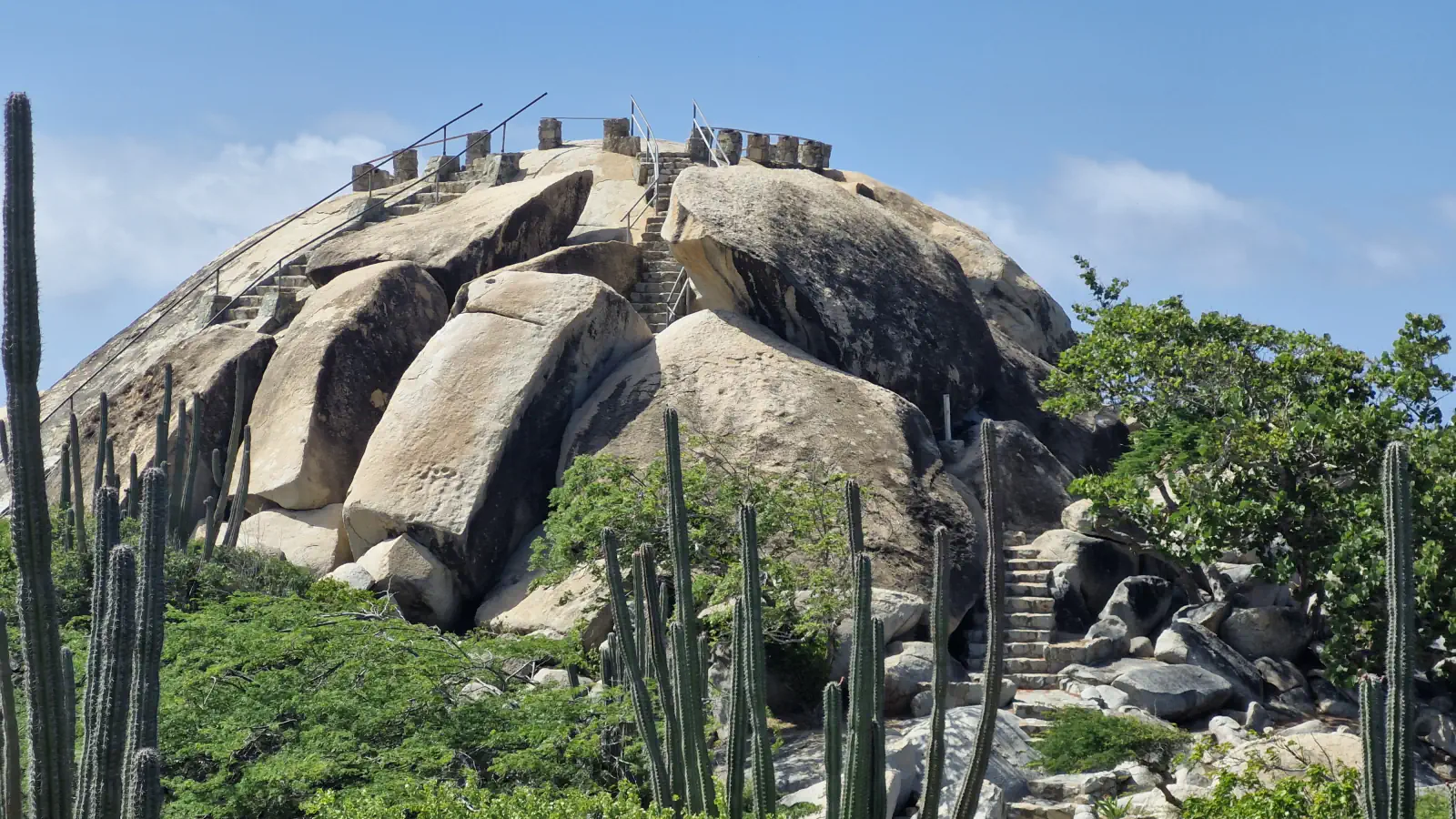
Two journal papers set out different age interpretations for Aruba’s intrusive rocks. The 1978 study places the northwest tonalite at 85.1 ± 0.5 million years and the rest at 70.4 ± 2.0 million years, treating these dates as evidence of two intrusion episodes. For the crystalline core, the 1986 authors propose an oceanic-arc origin. In their account, that crust collided in the Santonian with the passive margin along northern South America. Their age estimate for the composite tonalite-and-gabbro batholith is 88.5 ± 0.8 million years. VisitAruba.com lists Hooiberg at 165 metres and uses “Hooibergiet” for a quartz-diorite variety; Aruba.com’s Casibari page identifies the local boulders as tonalite.[2][1][3][4]
Dates and motifs at Arikok and Ayo
Published accounts connect Aruba’s rock art to a longer island chronology. The Rijksmuseum van Oudheden places mainland-settlement traces about 3,500 years ago and Caquetío arrivals from Venezuela around 900–1000 CE; it links the paintings to the period when both communities were active. A 2023 AAN report about Sjoerd Martens’s book relays archaeologist Harold Kelly’s count of 458 documented images—456 paintings and two carved petroglyphs—and radiocarbon ranges for one example each at Arikok (776–1018 CE) and Ayo (1043–1275 CE). The report’s summary of Kelly’s palette distinguishes limestone caves, where paintings are nearly all red, from formations with red or white images; it also notes black examples at Rooi Taki. Archaeology’s 2014 profile contrasts the animal and bird figures by the Cunucu Arikok path with more elaborate human scenes on a nearby dolerite outcrop. Aruba.com’s caves page identifies Fontein as the cave with Arawak ceiling drawings.[5][6][7][8]
Western Wetlands and Spanish Lagoon: two Ramsar sites
These two Ramsar entries describe different wetland boundaries. Western Wetlands groups five saliña areas across 392 hectares; Spanish Lagoon covers 259 hectares after a 2023 enlargement from 90 hectares that added the central wetland’s catchment. Ramsar lists the lagoon’s designation date as 23 May 1980. Tidal flats and mangroves surround the lagoon, and Ramsar gives its narrow coastal inlet as about two kilometres long and 200–500 metres wide. The listing names Atlantic tarpon (Megalops atlanticus), cubera snapper (Lutjanus cyanopterus) and hogfish (Lachnolaimus maximus) as nursery users; it identifies hogfish as globally vulnerable. For the Western Wetlands, the Ramsar sheet describes saliñas as coastal marshes outside regular tidal exchange where seawater occasionally mixes with fresh water, changing salinity levels. It also records Cnemidophorus arubensis, the endemic Aruba whiptail.[9][10]
Good to know
A few clear answers before you explore.
What age estimates do two geology papers give for Aruba’s tonalitic rocks?
A 1978 paper interprets two intrusion episodes: 85.1 ± 0.5 million years in the northwest and 70.4 ± 2.0 million years elsewhere. A 1986 paper estimates the composite tonalite-and-gabbro batholith at 88.5 ± 0.8 million years.[2][1]
What dates are reported for rock art at Arikok and Ayo?
AAN reports radiocarbon ranges of 776–1018 CE for one image at Arikok and 1043–1275 CE for one at Ayo. The Rijksmuseum van Oudheden places the paintings in a period when Archaic and Caquetío groups were both active.[6][5]
What characterizes the saliñas in Western Wetlands?
The Ramsar entry covers five separate locations. It describes their marshes as beyond the normal tide cycle, where intermittent seawater mixing changes salinity; the sheet identifies Cnemidophorus arubensis as an Aruba-endemic reptile.[9]
The WorldStamped community
Every visit becomes part of a story.
- Members with public visits
- 0
- Places with public visits or memories
- 0
- Public memories
- 0
No public visits have been counted here yet. Add this destination to your own map and choose what you want to share.
Members are counted once. Counts include only eligible public activity from profiles that allow search discovery. Private and followers-only content is excluded.