City
Baku: an 1846 oil well, Villa Petrolea and the Ateshgah fire temple
Oil and fire link these Baku sites. A 21 m well was drilled at Bibi-Heybat in 1846; Villa Petrolea, built in the Black City for the staff of the Nobel family’s oil company, dates from 1884; and the Ateshgah at Surakhany, a temple complex of the 17th century, ceased to be a place of worship after 1883, according to Azerbaijan’s own Tentative List entry.
At a glance
- Country
- Azerbaijan[6]
A place worth remembering
Bibi-Heybat: the 1846 exploration well
In a 2025 Azerbaijan Oil Industry article, Mir-Yusif Mir-Babayev cites a Russian state-property report listing 136 wells on the Absheron Peninsula in 1842, then recounts an exploratory well drilled at Bibi-Heybat in 1846. Proposed by Vasily Semyonov and supervised by Major Alekseyev, it reached 21 m.[1][7]
Villa Petrolea: the Nobel company’s estate in the Black City
Villa Petrolea stands on 8 November Avenue in the district called the Black City. ERIH, the European Route of Industrial Heritage, lists a mansion of 1884 built by the Nobel family’s Branobel company, with houses for 100 employees, a school, a hospital, a theatre and a club, and a 10.5 ha park laid out with imported soil and plants. The Branobel History site adds that the main house was cooled with compressed air and with ice brought from the Volga in winter. The Baku Nobel Heritage Fund restored the villa, with an opening ceremony on 25 April 2008, and it now holds a Nobel Brothers’ Museum.[2][3]
Surakhany: a pentagonal fire temple and the petroleum plants
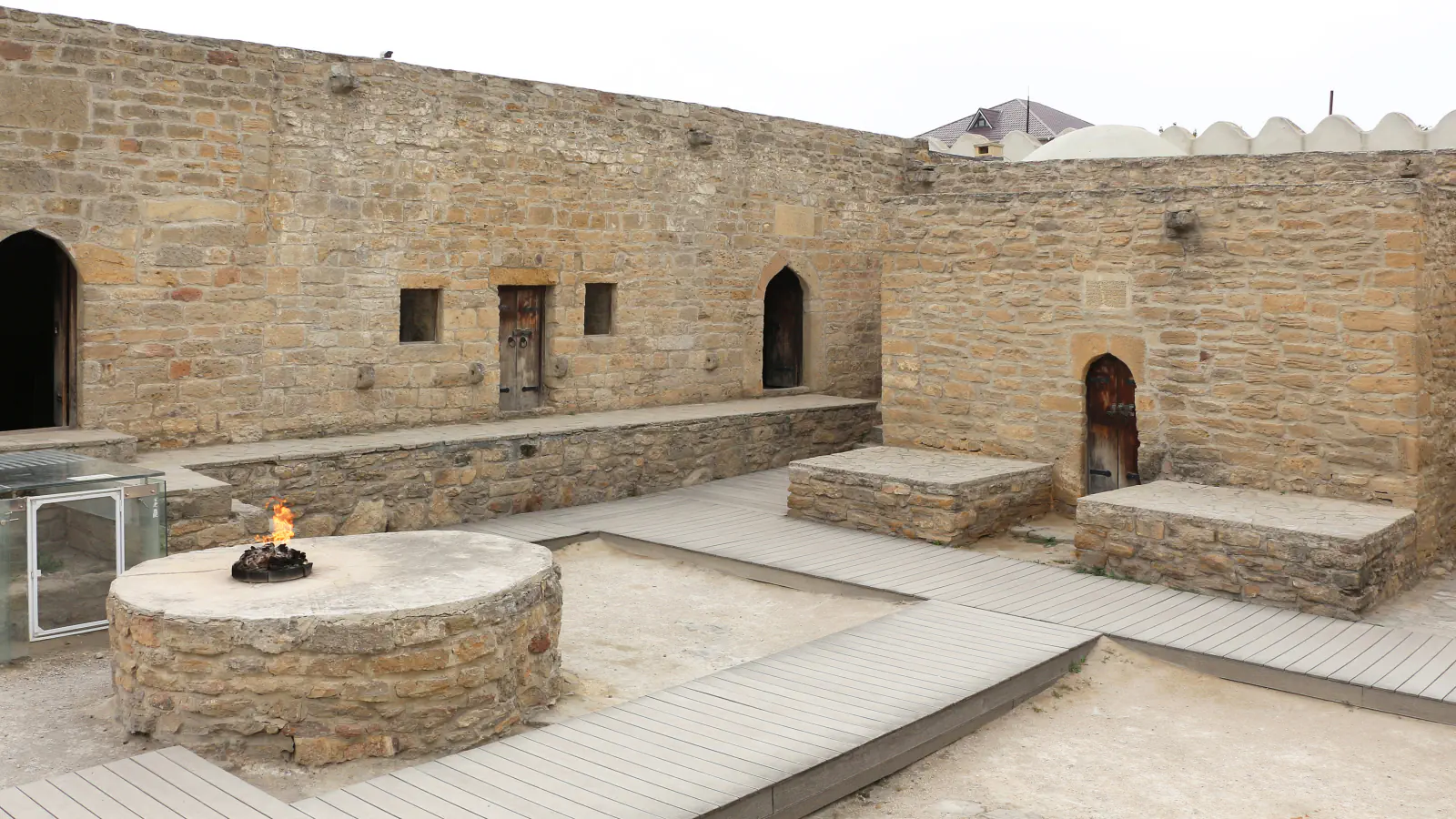
The Ateshgah lies in Surakhany, within greater Baku and about 15 km north of the city on the Absheron Peninsula. The entry Azerbaijan submitted to UNESCO’s Tentative List in 1998 dates the present buildings to the 17th century and describes a pentagonal complex with an open courtyard and a four-pillar altar in the middle. It was a pilgrimage and philosophical centre for fire worshippers from Multan, who also traded with the Caspian area, and the entry says worship ended after 1883, when petroleum plants were installed at Surakhany. The Azerbaijan Tourism Board describes the site as an open-air museum.[4][5]
Good to know
A few clear answers before you explore.
Where was the oil well of 1846 drilled?
At Bibi-Heybat, in Baku. SOCAR and Mir-Yusif Mir-Babayev’s 2025 article in Azerbaijan Oil Industry both give the year 1846 and a depth of 21 m.[1][7]
When did worship at the Ateshgah end?
Azerbaijan’s Tentative List entry, published by UNESCO, says it ended after 1883, when petroleum plants were installed at Surakhany. That date is the entry’s own statement; the entry was submitted on 30 September 1998.[4]
What is inside Villa Petrolea today?
ERIH describes the Nobel family’s mansion as housing an oil-industry museum; it reopened to visitors in 2008 after restoration, together with a club and conference centre. The Branobel History site lists a Nobel Brothers’ Museum, an International Conference Centre and the Baku Nobel Oil Club, and dates the ceremony that opened the renovated villa to 25 April 2008.[2][3]
The WorldStamped community
Every visit becomes part of a story.
- Members with public visits
- 0
- Places with public visits or memories
- 0
- Public memories
- 0
No public visits have been counted here yet. Add this destination to your own map and choose what you want to share.
Members are counted once. Counts include only eligible public activity from profiles that allow search discovery. Private and followers-only content is excluded.